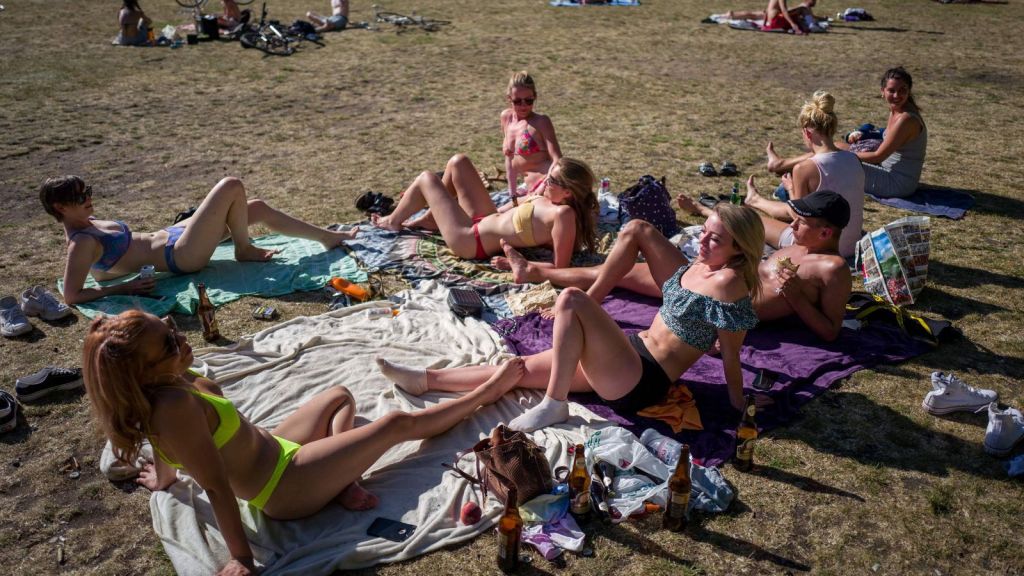
This image, from the Sun newspaper, supports an article discussing the ‘test and trace’ system being launched throughout the U.K. and the possible dangers of coming into close contact with asymptomatic individuals’, now lockdown measures have been somewhat lifted. Personally, I feel that since the ‘rules’ have been relaxed in Scotland, a minority of people certainly aren’t respecting them. As I live beside a beach that has been visited regularly by many people over the last few weeks due to the good weather, I have become all too familiar with witnessing scenes like that seen in the image. Of course, I’m as happy as the next person that some ‘normality’ has been brought back into our lives, but this needs to be done sensibly and respectably. The original caption reads, “With coronavirus often asymptomatic, without contact tracing it’s hard to know if you’ve been near an infected person”.
Negative captions
“Individuals’ ignoring government guidelines now coronavirus lockdown measures have been relaxed. But, at what cost?”
“Respect social distancing to avoid close contact with asymptomatic Covid carriers.”
“New Covid cases likely. But who will be to blame? The public or Government?”
Positive captions
“Freedom from full lockdown! Soaking up the sun after weeks of being stuck indoors.”
“Sun, sea and friendships reunited. A sense of normality now measures eased.”
“Life’s a beach now lockdown rules relaxed.”
Re-contextualised captions
“The man with seven wives. Fury as marriage laws change in U.K.”
“Skin cancer in U.K. at an all-time high. People urged to use sunscreen.”
“Bikinis in the U.K. to be banned from next year. Some women already adjusting for the change.”
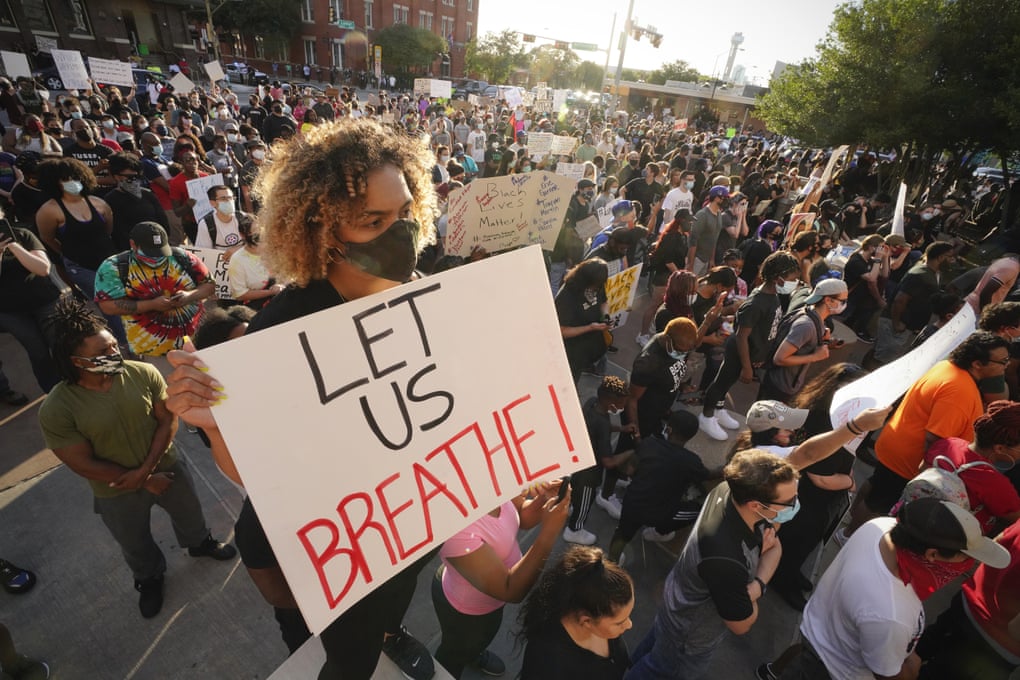
This image, from the Guardian newspaper, supports an article about the murder of George Floyd whilst in police custody, and subsequently, the protests that followed – some peaceful, some not – specifically seen across America. Most believe this was a pre-meditated and racially motivated murder – as Floyd was a black man – rather than a case of bad policing. Unfortunately, racial profiling by police officers – specifically towards black individuals’ – has become all too familiar in recent years across the U.S. In response, social movements such as ‘Black Lives Matter’ have been created to raise awareness of the problem. “Let us breathe” has become the ‘message’, if you will, seen throughout the protests, and symbolises Floyd’s last words “I can’t breathe”, as a result of a police officer kneeling on Floyd’s neck, whilst he was unarmed, handcuffed and lying face down on the road. The original caption read ‘How the killing of George Floyd has upended America’.
Negative captions
“Second wave of Coronavirus feared, as mass crowds gather for George Floyd protest.”
“Masks being used to conceal identities NOT for Covid protection.”
“Reading between the lines will result in more deaths on black individuals’ at the hands of the police.”
Positive captions
“George Floyd protestors show signs of hope.”
“One race unified.”
“Peaceful protesters air their views.”
Re-contextualised captions
“Californian residents raise concerns over rising pollution levels.”
“Americans angered. Wearing masks to combat Covid-19 to become mandatory.”
“Inhalers run out of production in some U.S states. Asthma sufferers concerned.”
This exercise showed me that it’s actually very easy to use text in the form of captions, in order to solidify meaning to an image, as long as what is written has some relevance to what is being shown. Captions are primarily used to give an insight into the story that relates somehow to the photograph. However, whether an image has positive or negative connotations – regardless of what is depicted – depends entirely on the captions used. I also learnt that one image could have multiple captions attached to it, where in theory, each created a different story surrounding the photograph. I’m not certain that photograph captions are ever used in a dishonest manner when featured in newspapers or magazines. However, if they weren’t featured alongside a main article, the truth could certainly be questionable.
Thinking about how I could use what I’ve learnt in my own work, perhaps an interesting project would be to produce a series of images’ that portray both positive and negative scenes, but use connotations that are the opposite to what is being portrayed. Could using text in this regard change the meaning of an image that isn’t considered neutral – like those I used for this exercise.
References
The Guardian. (2020). ‘Protests rock cities across US as anger over George Floyd’s killing spreads’ [online] Available from: https://www.theguardian.com/us-news/2020/may/29/george-floyd-killing-protests-us-police
Sky News. (2020). Coronavirus: ‘How will England’s test and trace system work?’ [online] Available from: https://news.sky.com/story/coronavirus-how-will-englands-test-and-trace-system-work-11995695

 Iain Barbour - BA (Hons) Photography