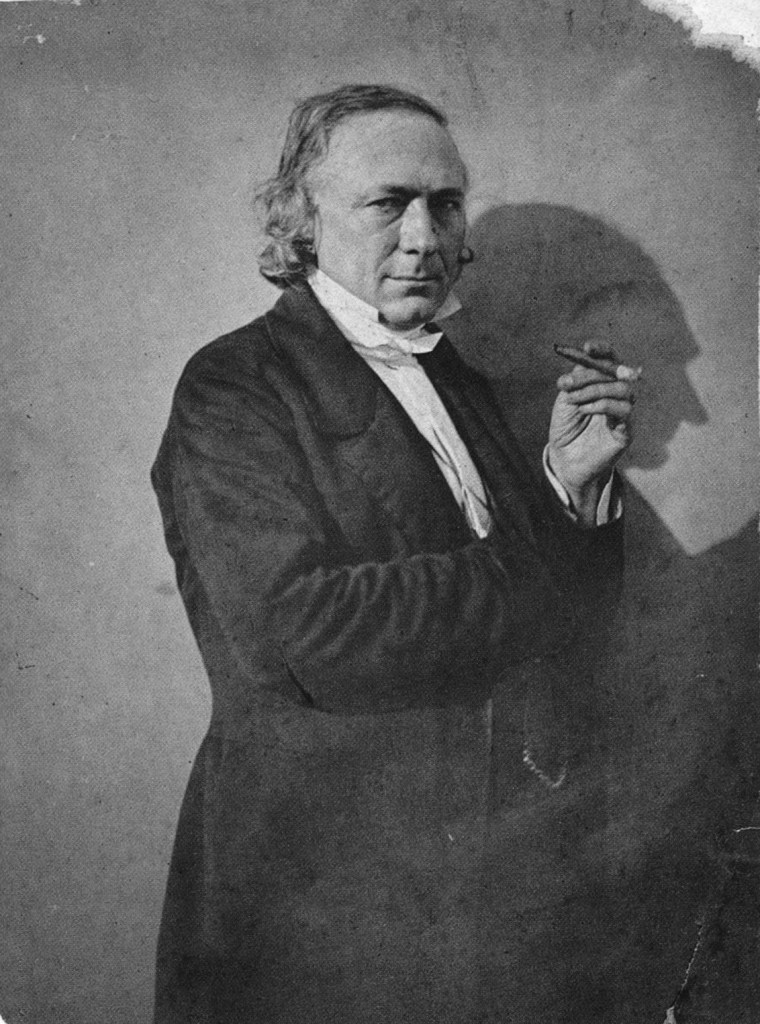
My chosen image is that of French caricaturist, Charles Philipon, taken by the famous French photographer, Felix Nadar. In the photograph, Philipon is presented to the viewer, turned slightly side on from the camera and standing in a way which depicts a sense of confidence within himself. The folding of one arm confirms he is comfortable with his surroundings and with Nadar taking his portrait. Perhaps, there is a mutual respect between the two men, as Nadar himself was too a talented caricaturist. At first glance, Philipon may come across as an authoritarian, due to his small and stern looking eyes looking directly down the face of the lens. However, the slightest of rise smiles, I think, shows his true character which is that of a witty individual who doesn’t take life too seriously – a perfect characteristic for the profession he is in. Saying that, Nadar was the master of using wit to make his subjects feel at ease and help them to ignore their possible anxieties surrounding being photographed. Is it possible that on this occasion, the shutter was pressed at the exact time Nadar made a comical joke? The relevance of Philipon holding a cigar is still unclear to me. There are no other portraits of him holding such paraphernalia or written documents that state he liked to smoke them. Nadar, did like to use props on occasion that had some significance to the subject, but why not usea pen? Perhaps, this was Philipon’s decision?
To help with Nadar’s philosophy of working in a “relaxed and personal manner” to create the best images possible, he always worked within a familiar environment – his home. This particular portrait was taken in Nadar’s Parisian back garden in 1854. By using a plain, white backdrop, Philipon, dressed in a black suit, becomes the focus instantaneously. With him wearing a white shirt that flares out towards his neckline, the viewers’ eyes are drawn upwards, towards his face – the main focal point of the portrait. Though, Nadar was a revolutionary in the use of artificial light for photography, in this instance, he used the natural light of the sun to help highlight Philipon’s face. Cleverly, though perhaps unintentionally, a shadow of Philipon has been cast onto the backdrop, creating a caricature of himself. Not only does this set up, choice of attire and use of natural sunlight help reinforce Philipon’s class and status, it has also been cleverly used to address photographic conventions, such as simplicity, leading lines, symmetrical balance and framing.
Nadar’s approach to taking portraits was to use the wet plate collodion negative process. By using this technique, any number of prints could be made, which wasn’t possible with the older and by this time, the less favourable daguerreotype. This would have been advantageous for someone with wealth, like Philipon, as, not only could he purchase prints for himself, but, also for family, friends and business acquaintances.
References
The Guardian. (2015). ‘The absurd life of Felix Nadar, French portraitist and human flight advocate’ [Online] Available from: https://www.theguardian.com/books/2015/dec/23/books-felix-nadar-france-photography-flight
The Public Domain Review. (2019). ‘Photographs of the Famous by Felix Nadar’ [Online] Available from: https://publicdomainreview.org/collection/photographs-of-the-famous-by-felix-nadar
The Met. (2004). ‘Nadar (1820-1910)’ [Online] Available from: https://www.metmuseum.org/toah/hd/nadr/hd_nadr.htm
Time. (2017). ‘How Nadar became the first great portrait photographer’ [Online] Available from: https://time.com/4846969/nadar-biography/
Imaging Resource. (2013). ‘The incomparable Nadar: Master photographer, political cartoonist and balloonist of 19th century Paris’ [Online] Available from: https://www.imaging-resource.com/news/2013/03/22/the-incomparable-nadar-master-photographer-cartoonist-balloonist-of-paris
 Iain Barbour - BA (Hons) Photography