Exercise 1: Looking at Advertisements’

I thoroughly enjoyed this exercise, and it was great to recap on specific aspects, which I came across from the ‘Context and Narrative’ module. I decided to concentrate on ‘looking at adverts: 2’ posted on 15/09/14, where Woolley deciphers an advert that is promoting a ‘Protein World’ product. I thought it would make for an interesting task, to read Woolley’s post, after I had deciphered the advert for myself, then compare our thoughts and findings.
Throughout, I took into consideration the notion of ‘semiotics’, and more specifically ‘denotation’ and ‘connotation’, which is essentially the relationship between an object within the image, and its meaning, i.e. signifier and signified.

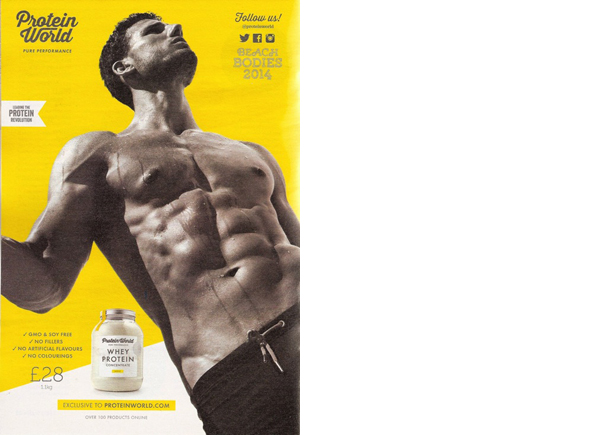
Denotation = Yellow background.

Connotation = The visually striking background highlights the muted tones of the model and text very well. It also reflects the labels seen on the product itself, and if one were to visit the businesses website, they would noticed the same colour features throughout. The same vibrant yellow is often seen in pop-art pictures, and though they originated in the 1950’s, they certainly had a modern quality for that period. Even today, pop-art is considered ‘trendy’ and is an attractive movement to follow by the younger generation. If we consider psychology and the meaning behind the colour yellow, it represents such things as, energy and emotional strength, but also depression. I found this very interesting when considering the product involved, as many people turn to living a healthier lifestyle – both physically and mentally – if they view themselves as being unhealthy, which can often lead to depression. It could also be a very clever marketing scheme, where sublimely, by using this colour, individuals’ will look at this advert and think that if they don’t but this product, they will develop such things as, anxiety and depression. However, those individuals’ may need to have an understanding of psychology surrounding colours.
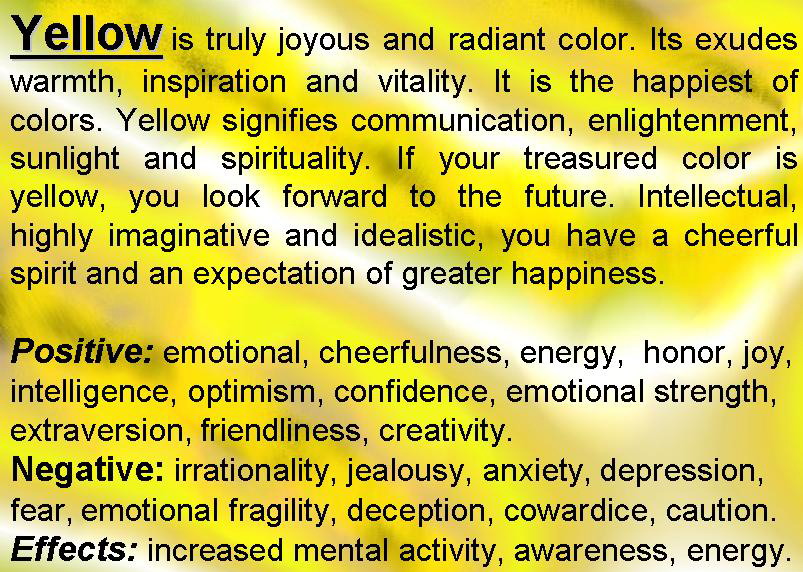
Denotation = Young / muscular male model wearing shorts and photographed at an obscure angle

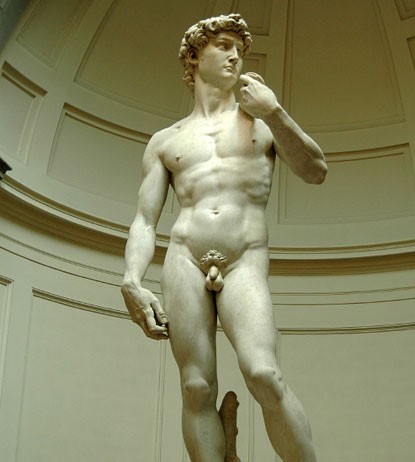
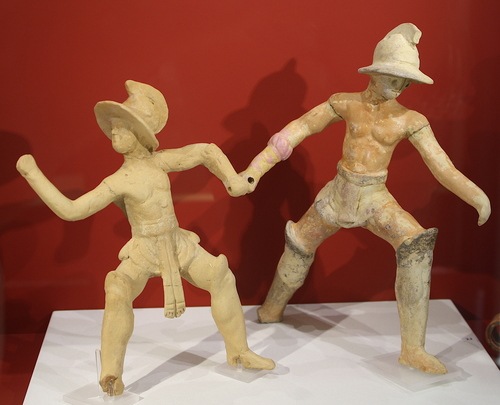
Connotation = The model represents fitness and strength, which is appropriate for the product being advertised. The obscure angle that they have chosen to photograph him has been purposely done to better define his muscles – more so on his chest and stomach – that may have not been as pronounced if photographed square on. The model reminds me of a marble statue one may see in Rome, which again is appropriate for the product, as this is a strong material, and was used as a symbol for purity and immortality. The shorts he is wearing reminds me of a canvas loin cloth that a gladiator would wear when in battle, and the way his right arm is bent, it could be imagined that he is holding a weapon. Gladiators symbolise courage, bravery and, perhaps more importantly in this case, strength.
Denotation = Whey protein product

Connotation = The product has been perfectly placed in the advertisement beside the muscular torso. The viewer’s eye will naturally be drawn to that area after reviewing the product, which, compared to the model, is small in proportion. Again, this has been cleverly thought out, as subliminally, it’s telling the viewer that by using the smallest amount of product, they will see huge gains in their physical appearance.

Denotation = Tag lines and social media icons

Connotations = “Follow us” has been used as a statement, almost like the brand is recruiting people to join an elite club, or start a “protein revolution”, to make changes both socially and culturally across the world. This is fitting to the companies name – ‘Protein World’ – where it gives the impression that the business works on a global scale. This may help promote both product and business, as people usually think along the lines of ‘the bigger the better’. The social media icons – relatable and available to the majority of people – will allow these individuals to join the club – so to speak – at a click of the button, thus promoting the business and product.

It was interesting reading Woolley’s thoughts on the advertisement. Though she picked up on some of the same things as I did, her interpretations of them were different, and as a result, so were her comments. This tells me that people ‘read’ photographs in different ways, and more often than not, the way we interpret what’s in an image and ultimately its meaning, depends on our historical, social and cultural backgrounds and understandings.

References

Open College of the Arts. (2014). ‘Looking at adverts: 2’ [Online] Available from: https://www.oca.ac.uk/weareoca/photography/looking-at-adverts-2/

Protein World. (2020). [Online] Available from: https://proteinworld.com/

Art Fido. (2017). [Online] Available from: https://shop.artfido.com/listing/2737247077/Yellow_Pop_Art_Lizard_in_Suit_Print_on_Loose_Canvas

Medium. (2013). ‘The Angel in the Marble’ [Online] Available from: https://medium.com/@nilsaparker/the-angel-in-the-marble-f7aa43f333dc

Ancient History Encyclopaedia. (2018). ‘Roman Gladiator’ [Online] Available from: https://www.ancient.eu/gladiator/
Assignment Three: Mirrors or Windows

Communities are an important factor in peoples’ lives, and there are a number of reasons why individuals’ choose to be a part of them. When we have a deep interest in something, for example, photography, most want to seek other like-minded people who share the same passion, and as a result, communities develop. As is often the case, we may not know who belongs to what community, or realise a ‘type’ of community even exists. Photography can act as a ‘window’ – in this instance – into communities that are not our own, and enables other’s to gain a better insight into them, and those involved. In an ideal world, time would be spent within these communities, talking to members and photographing important elements to help generate a better understanding for both the photographer, and the viewer. However, due to current affairs, I unfortunately didn’t have that liberty, and as a result, had to reconsider how I was going to find out about a community I knew little about.

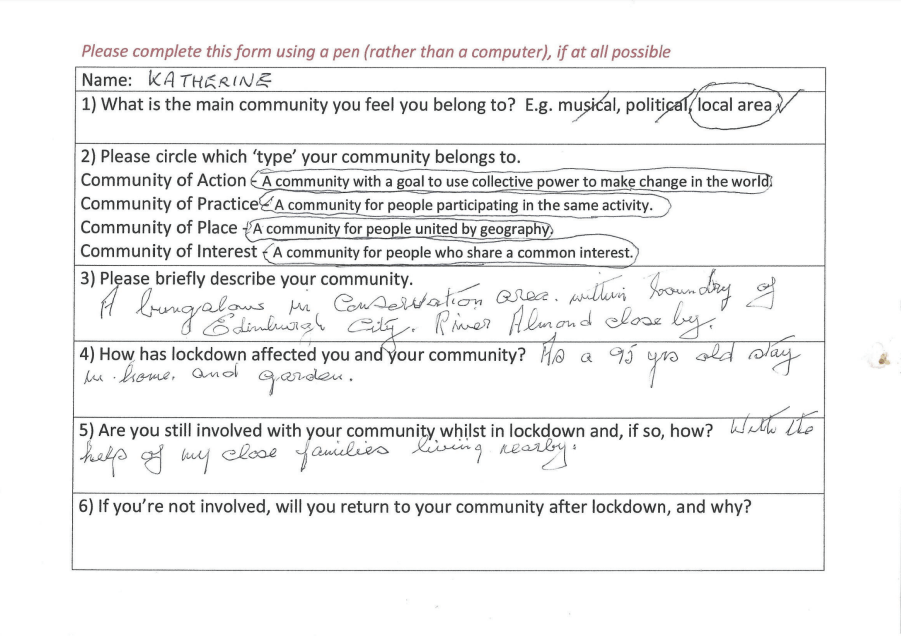
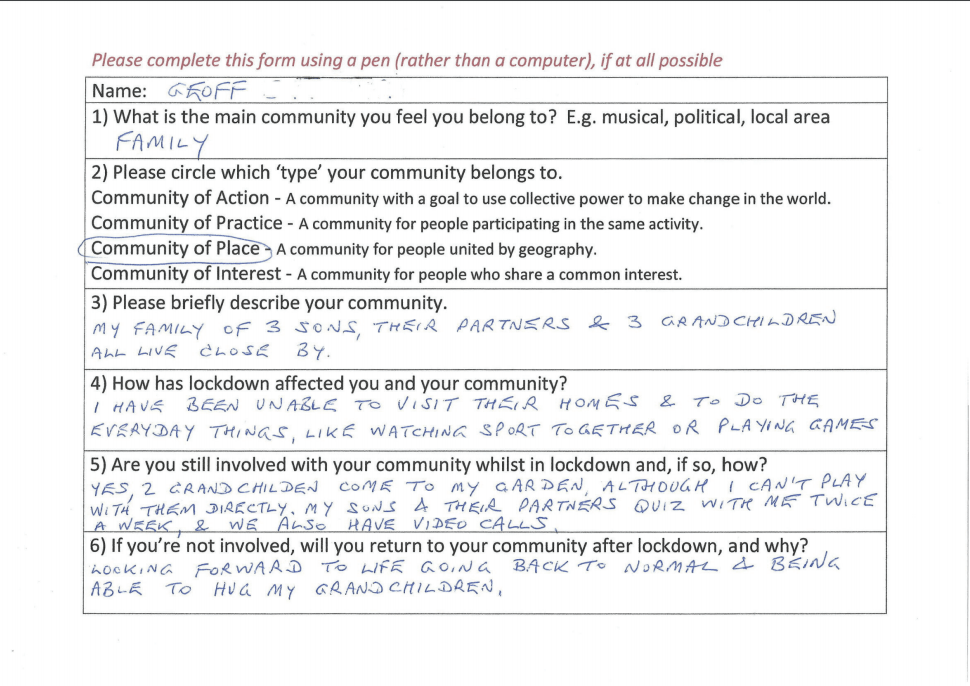
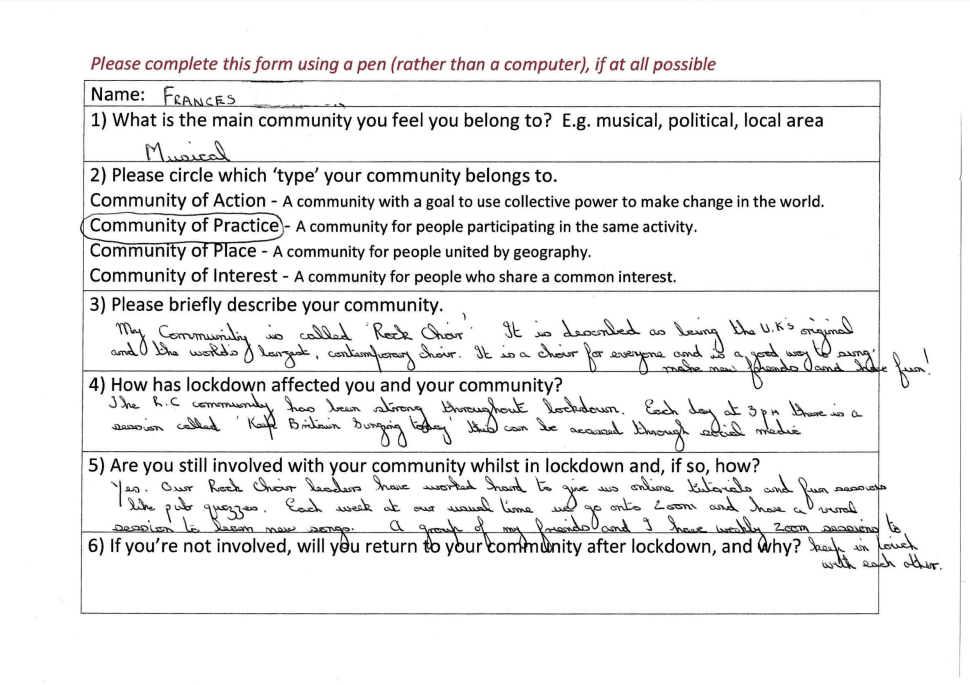
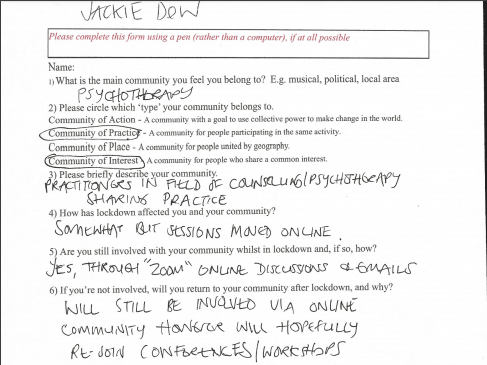
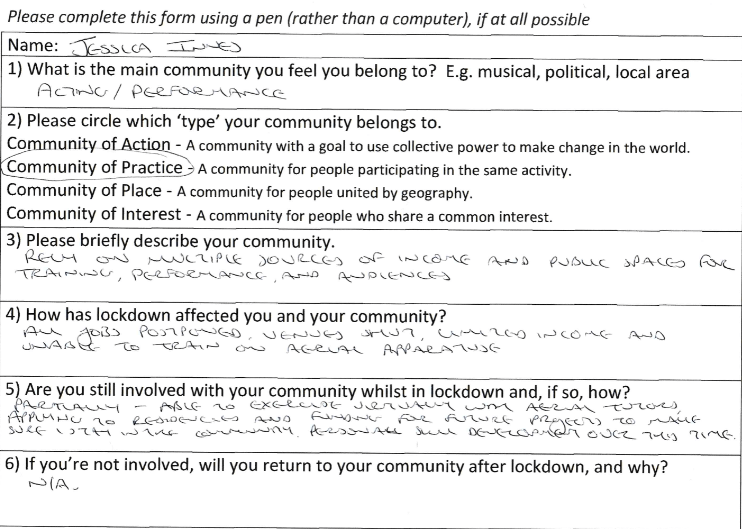
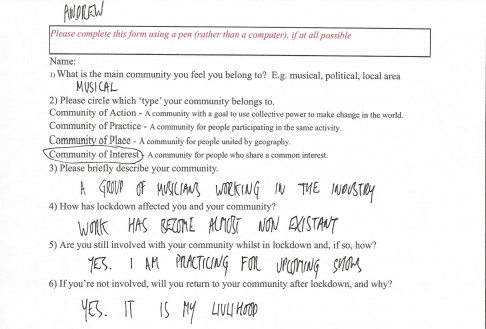
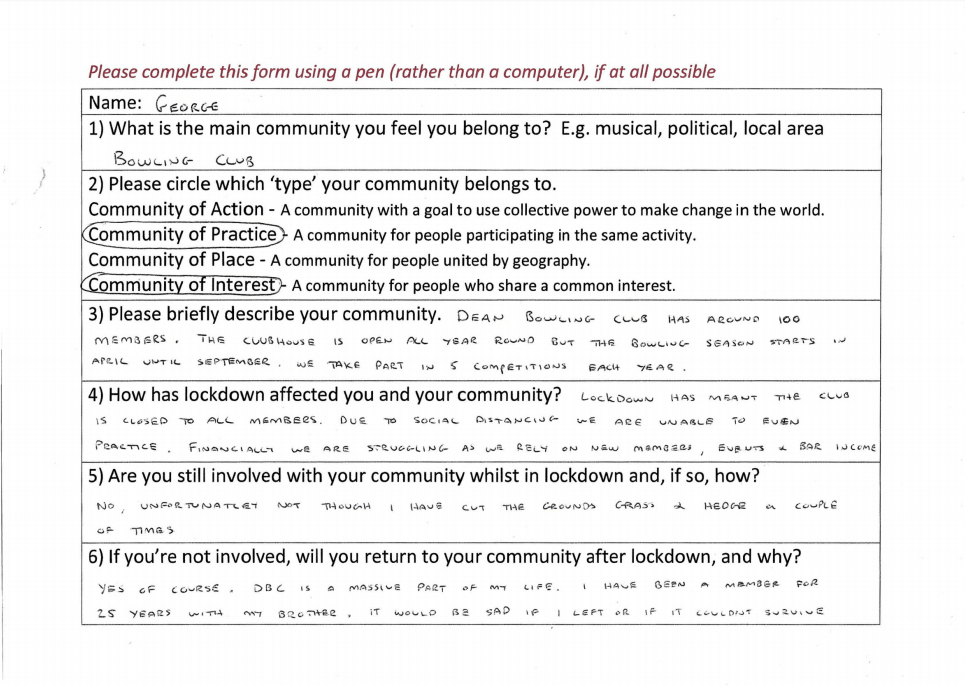
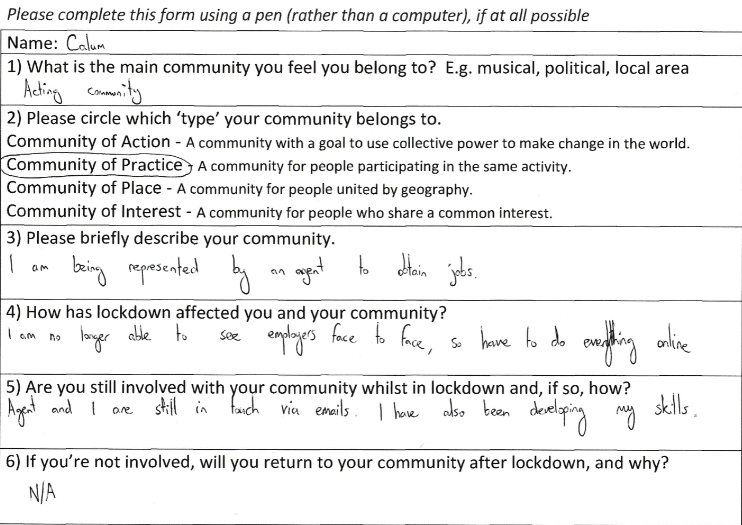
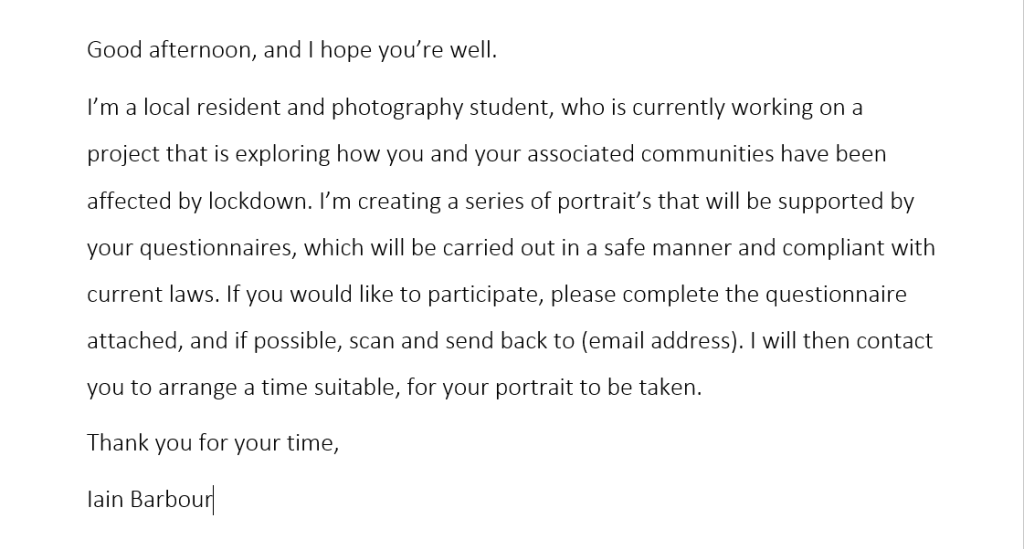
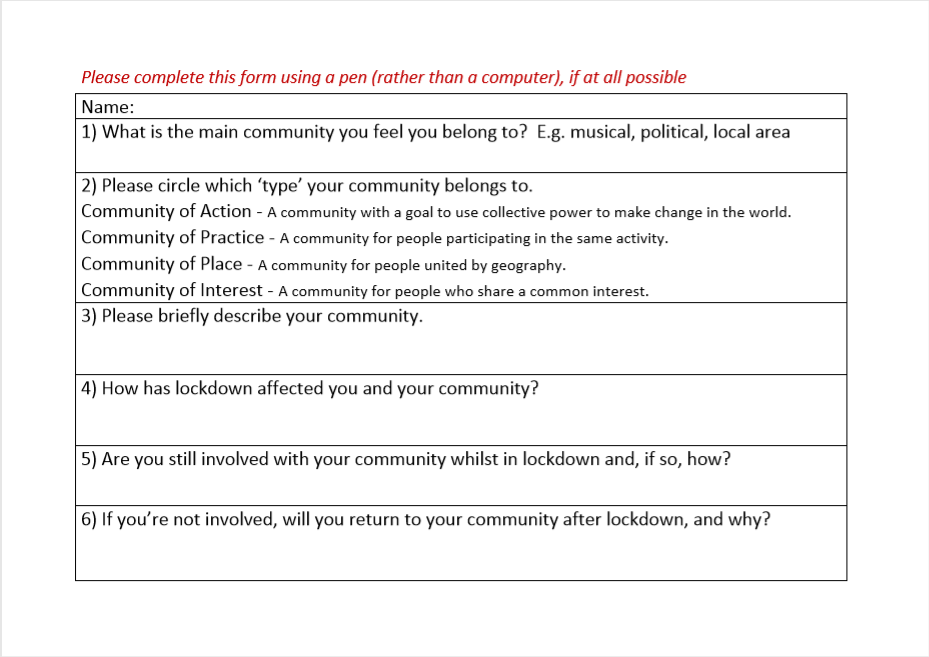
I took into consideration the notion of ‘community of circumstance’, which relates to people united by a common situation or challenge, not of their making. For example, lockdown. I saw this as an opportunity to find out on a broader scale, what communities’ people in my local area are involved in, and how both have been affected as a direct result of lockdown. In order to do this is a safe manner, I created a questionnaire, and along with a cover letter, delivered them to thirty homes along my street. Unsurprisingly, I only received eight responses.

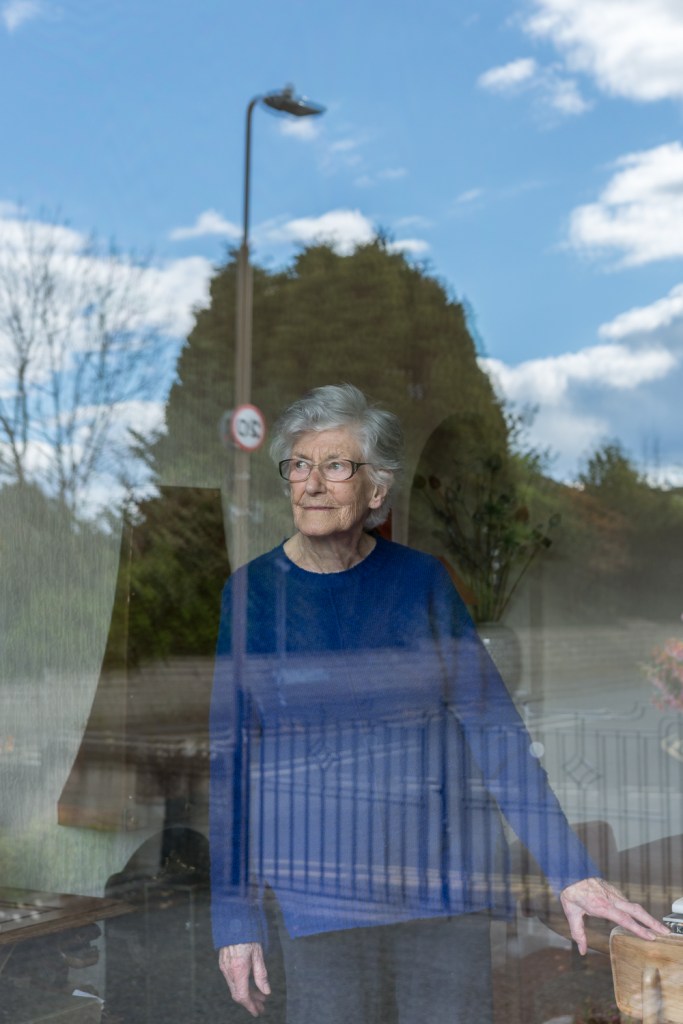
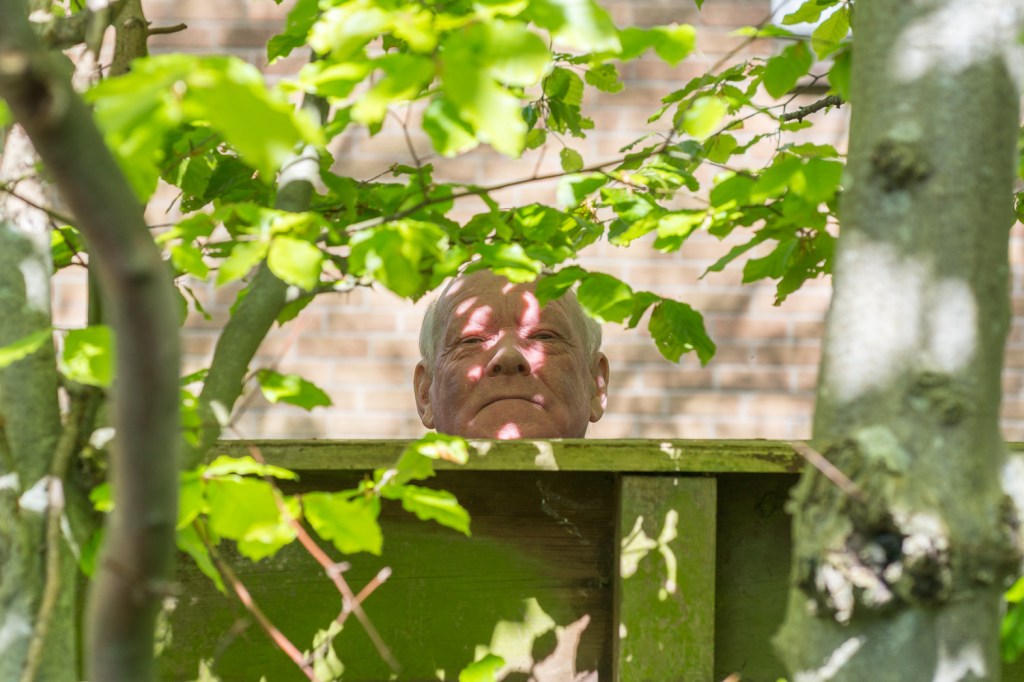
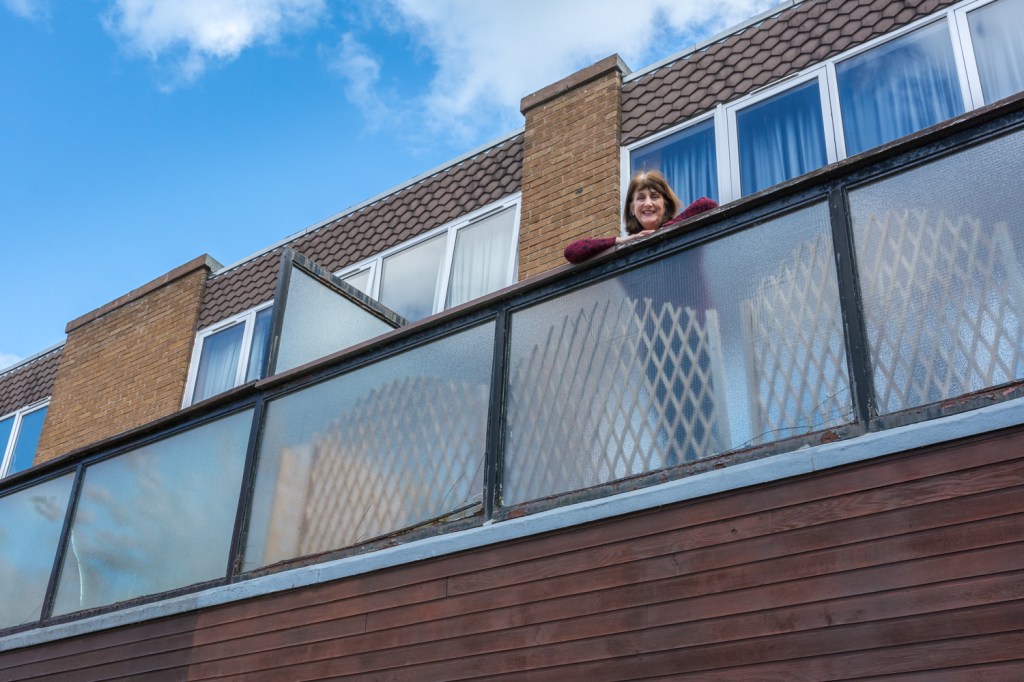
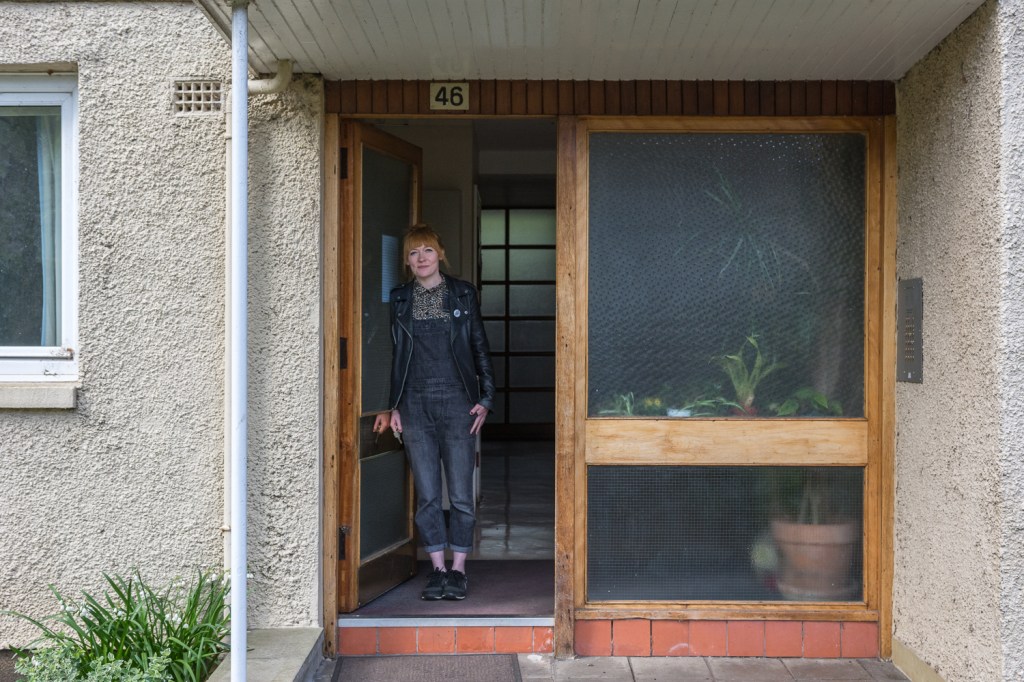
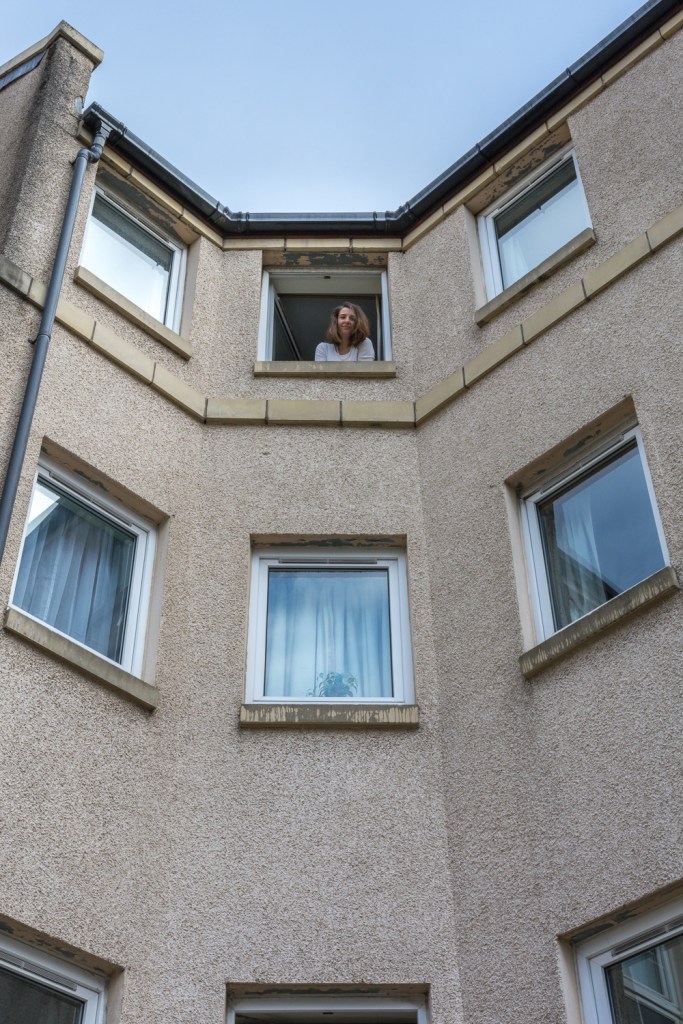
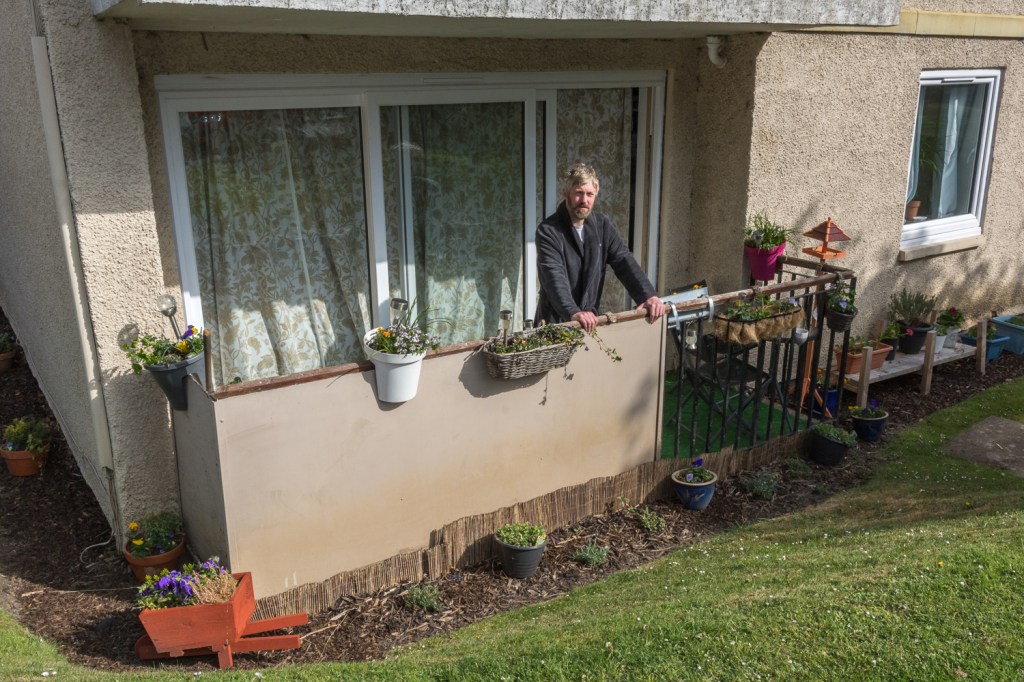
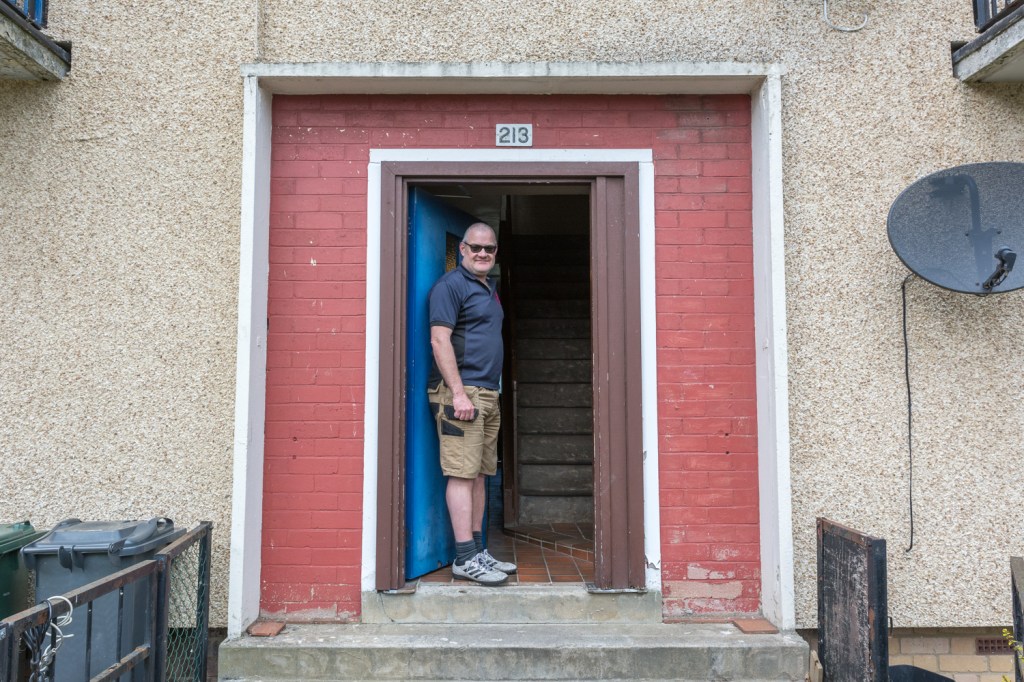
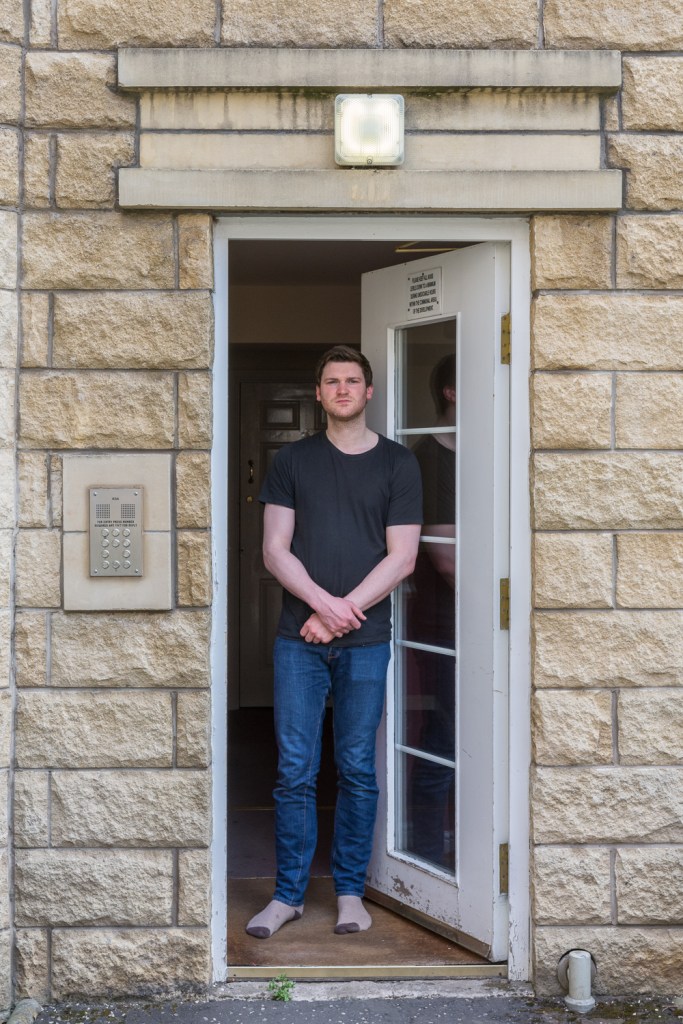
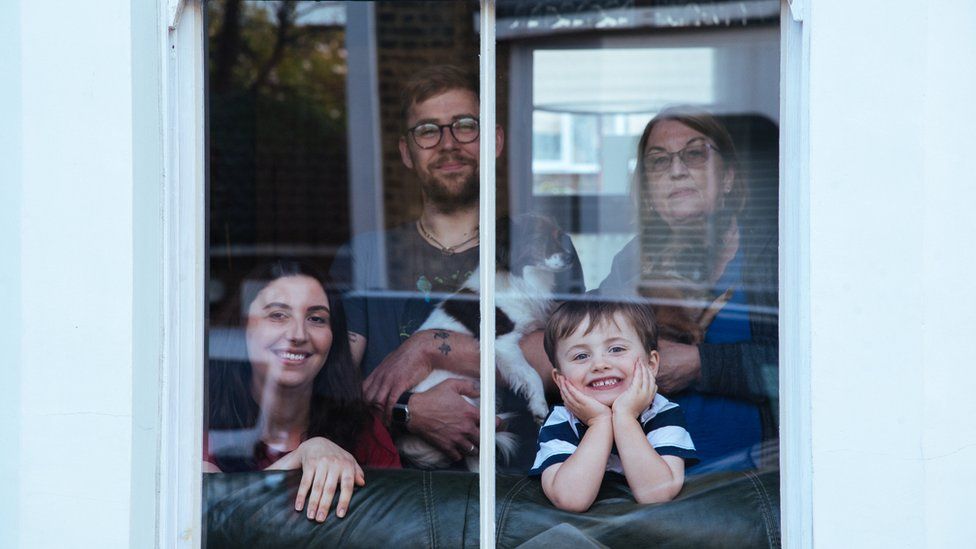
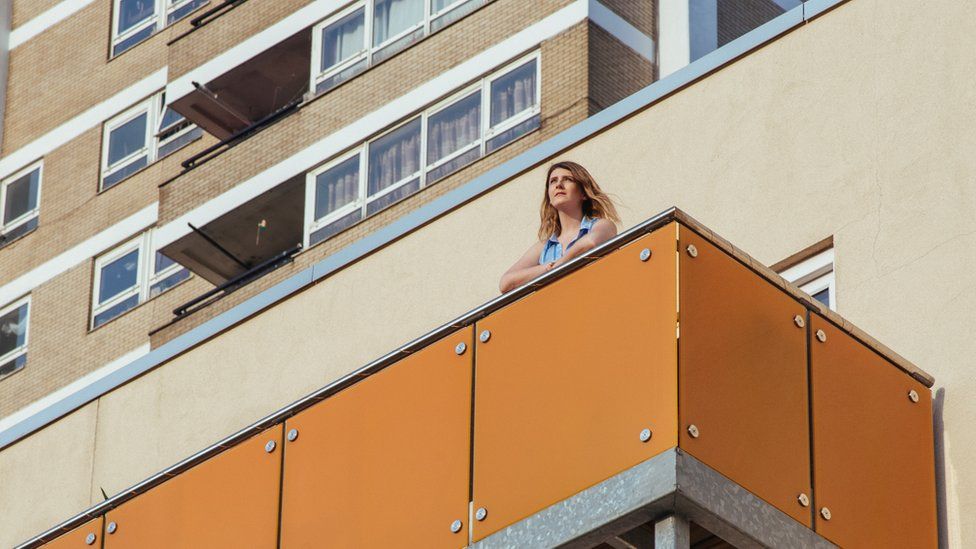
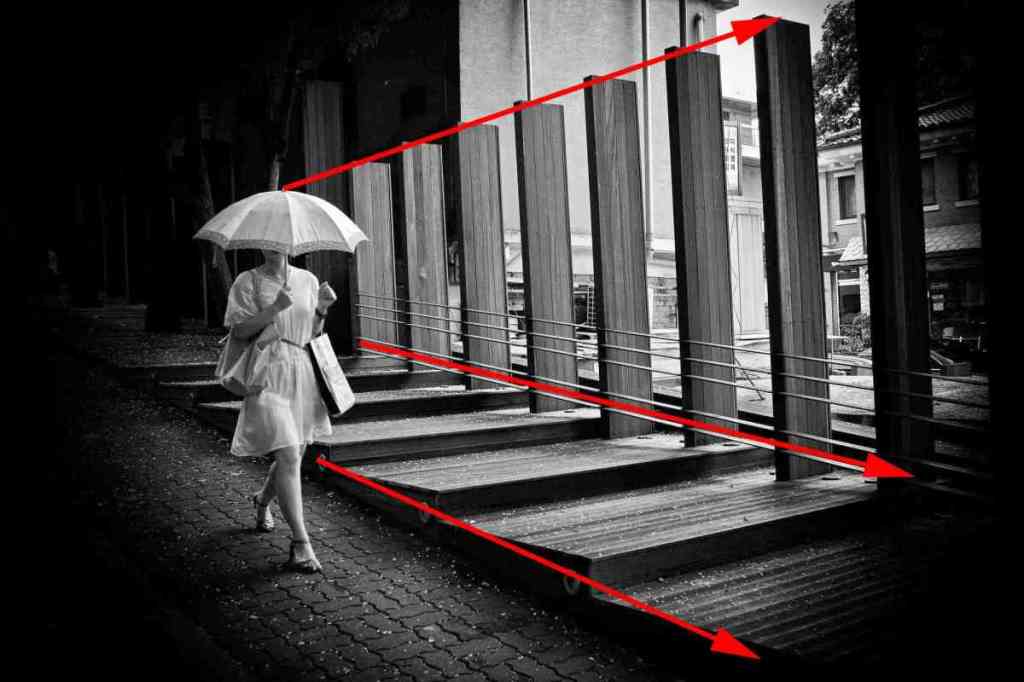
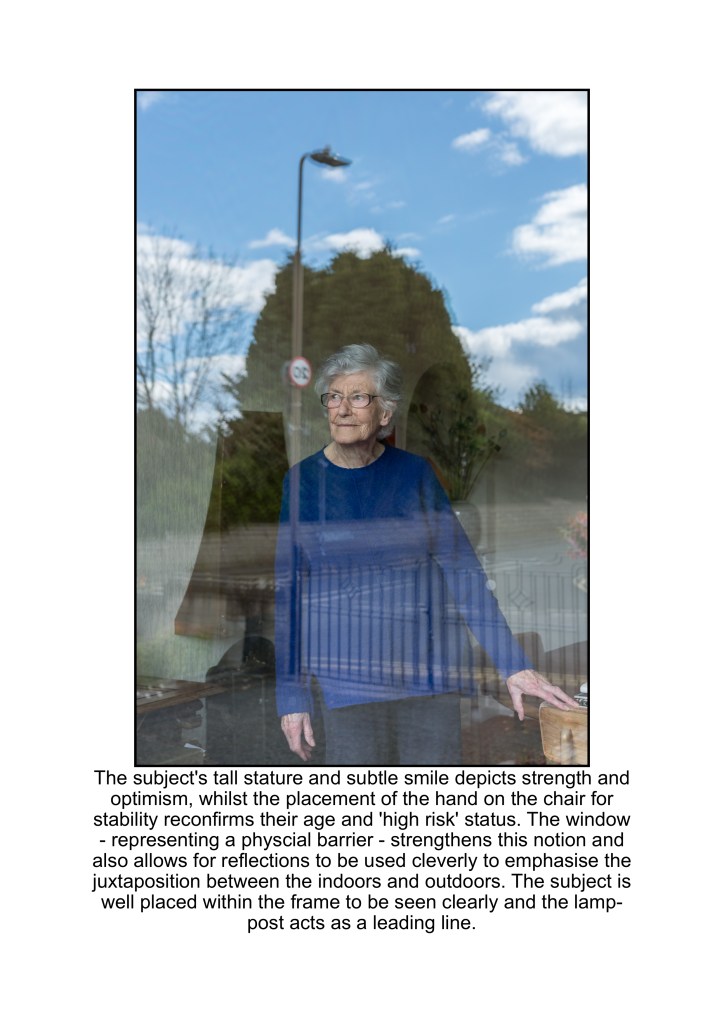
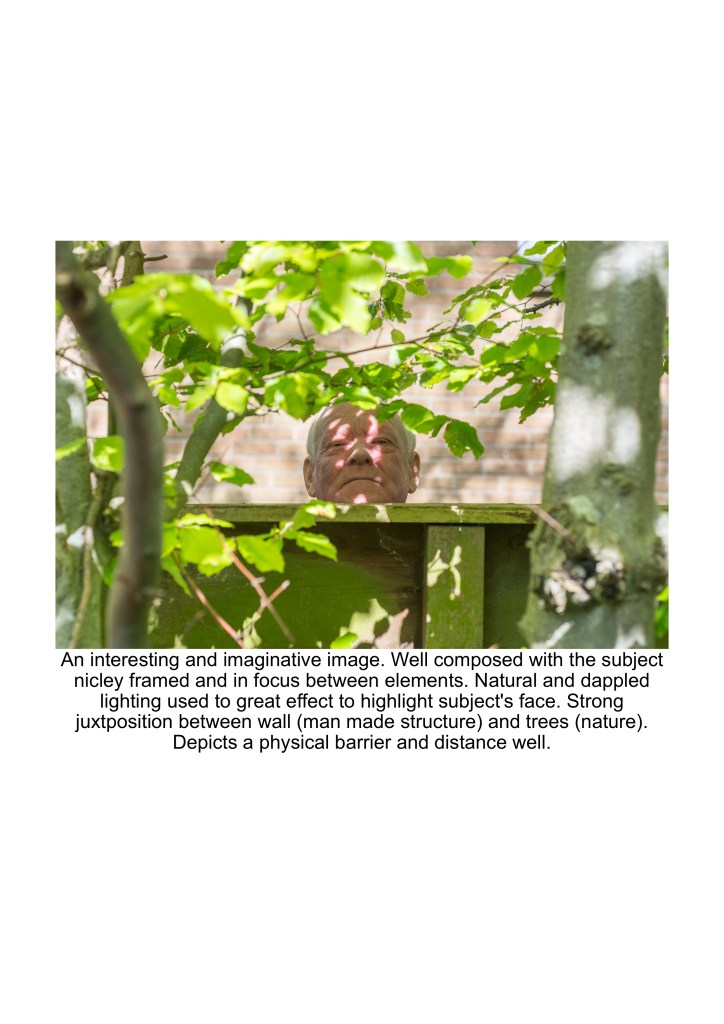
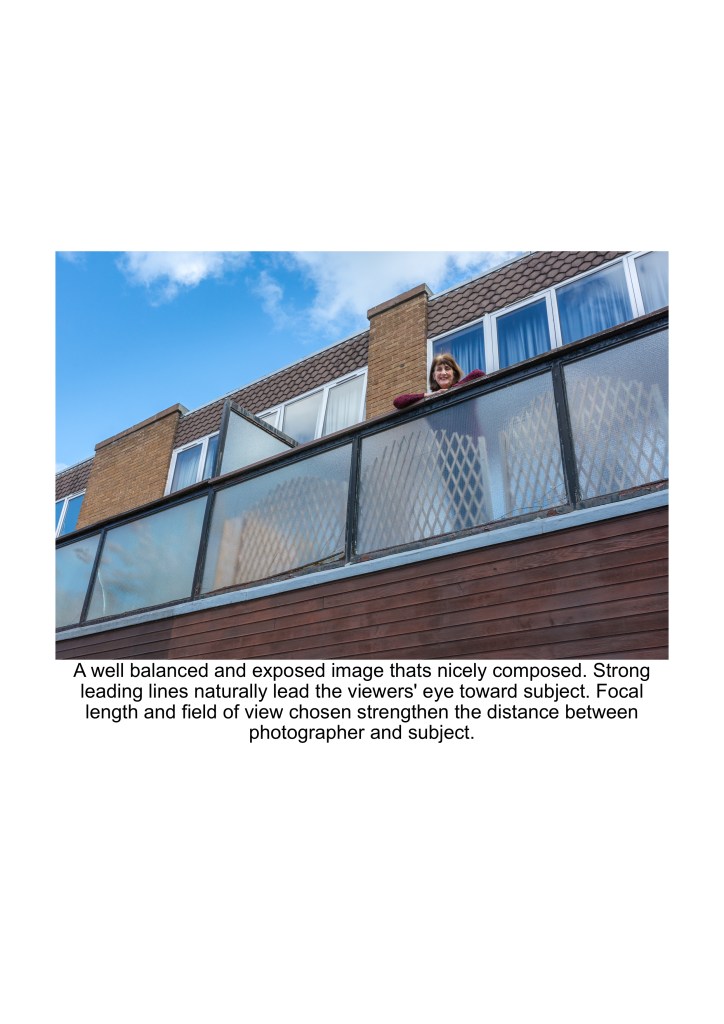
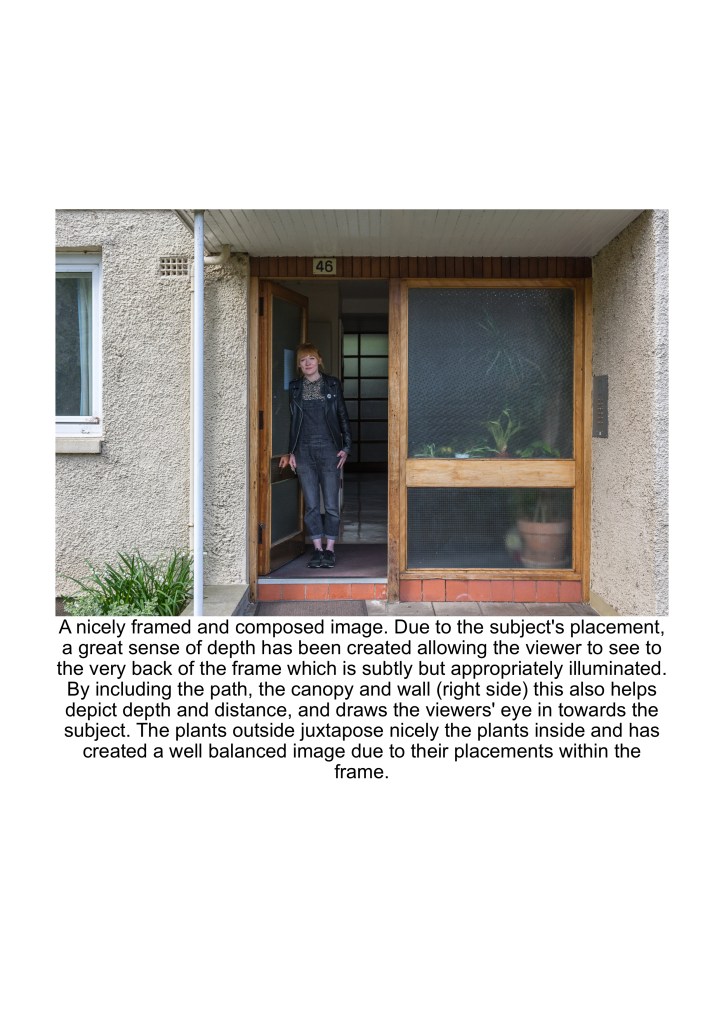
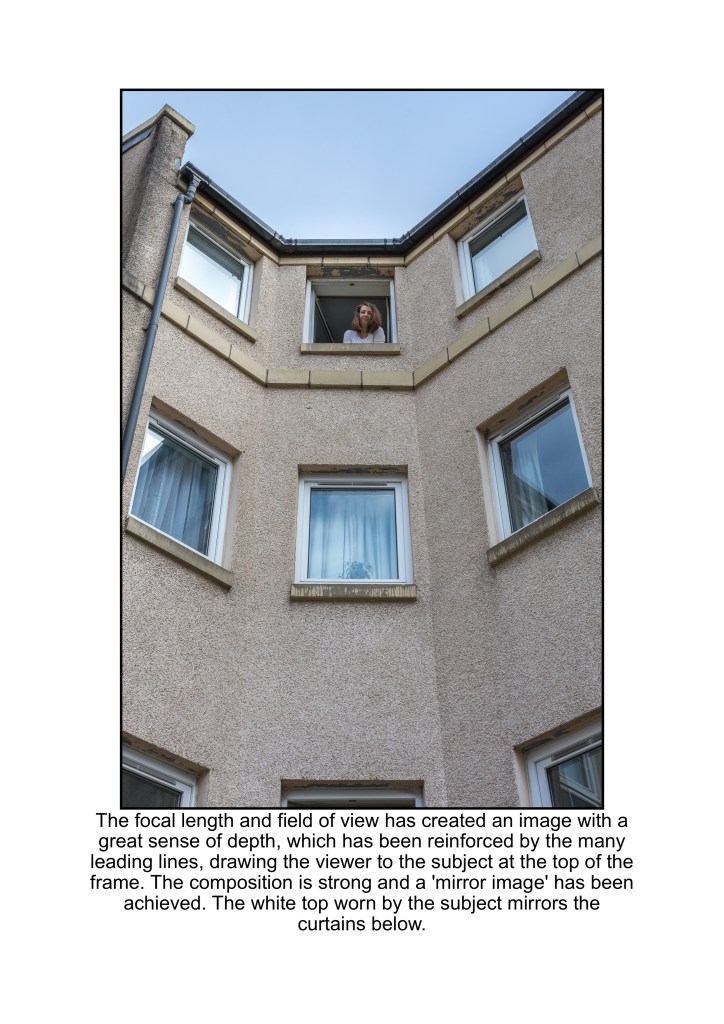
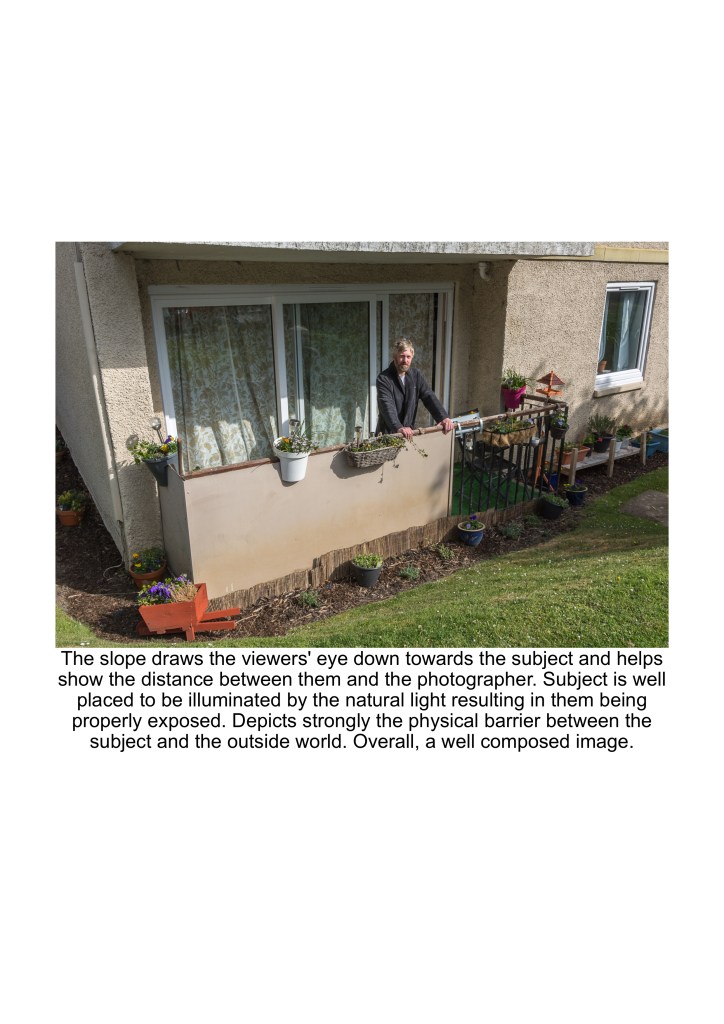
To emphasise the notion of social distancing and self-isolation within my portraits, I took into consideration the spatial relationship between myself and my subjects’, and where possible, used tangible elements that acted as physical barriers. However, to ensure that each subject didn’t become ‘lost’ in the space that I hoped to achieve, I incorporated leading lines created by objects present, in order to direct the viewer towards the subject, ultimately ensuring they would remain the point of interest. I tried to use other photographic elements and compositional techniques effectively. For example, creating a sense of depth within the image, by purposely placing subjects’ – where applicable – to the side of an open door frame, essentially making the scene appear bigger than it is, or by using the buildings structures to frame my subjects’ or to create a symmetrical balance. To make certain my portraits’ weren’t repetitive in style, I photographed my subjects’ in various locations – on balconies, through windows and in doorways alike. However, I made a conscious effort to create a juxtaposition between the ‘inside’ and ‘outside’, so chose to incorporate within the scene, both manmade and natural elements.

The final series consists of six portraits’ – supported by their relevant questionnaires – that I believe help strengthen the impression of social distancing and isolation, whilst giving the subjects’ a sense of identity in regards to the communities they are associated with. 

Assignment Three: Mirrors or Windows – Other portraits

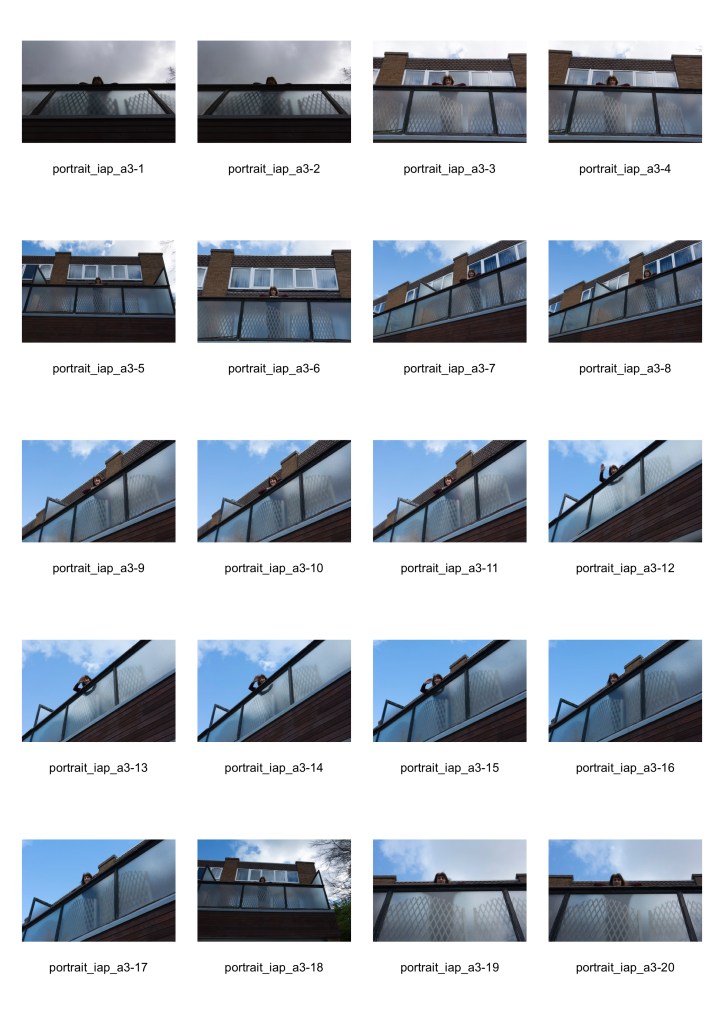
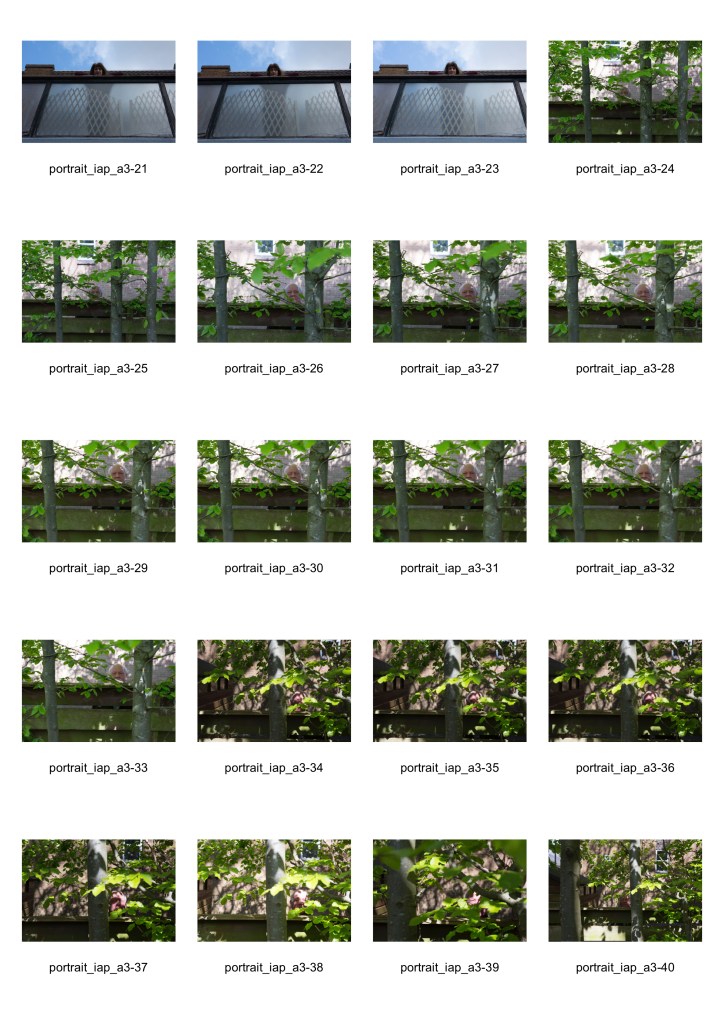
There were two other portraits’ which I took for this assignment. However, after some consideration, I didn’t feel they were suitable for the final series, and I’ll explain my reasons why.

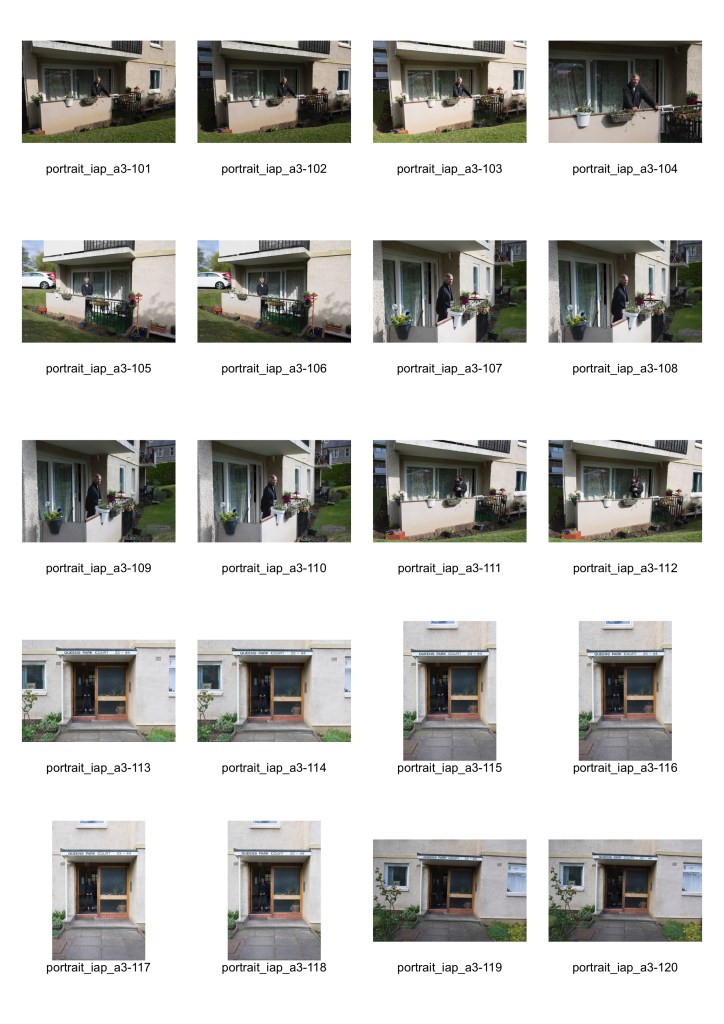
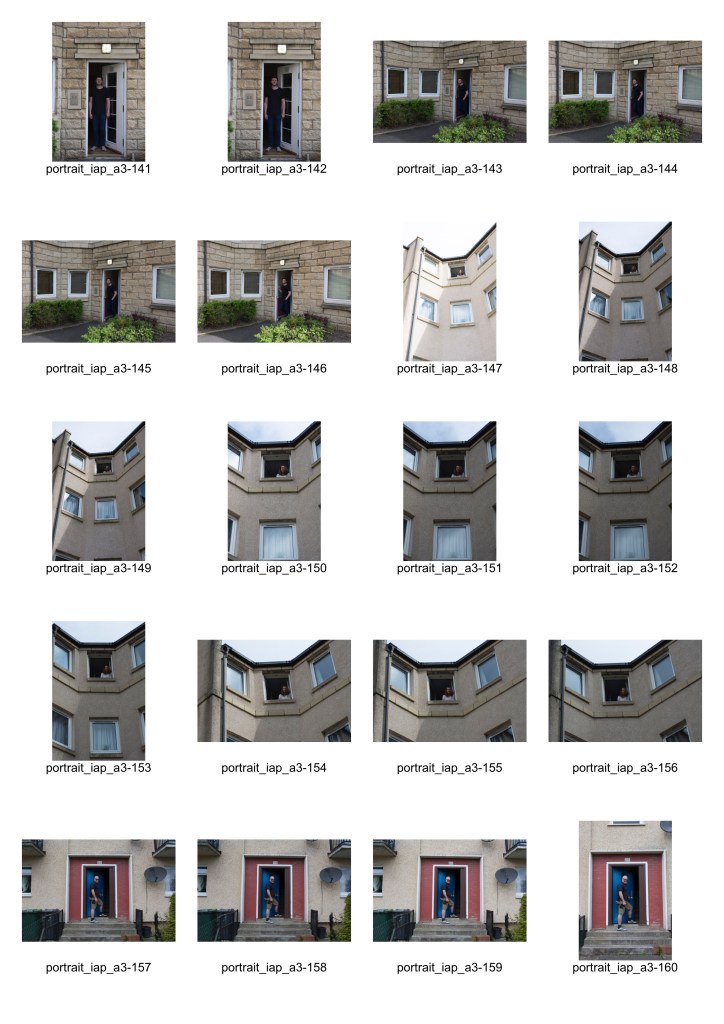
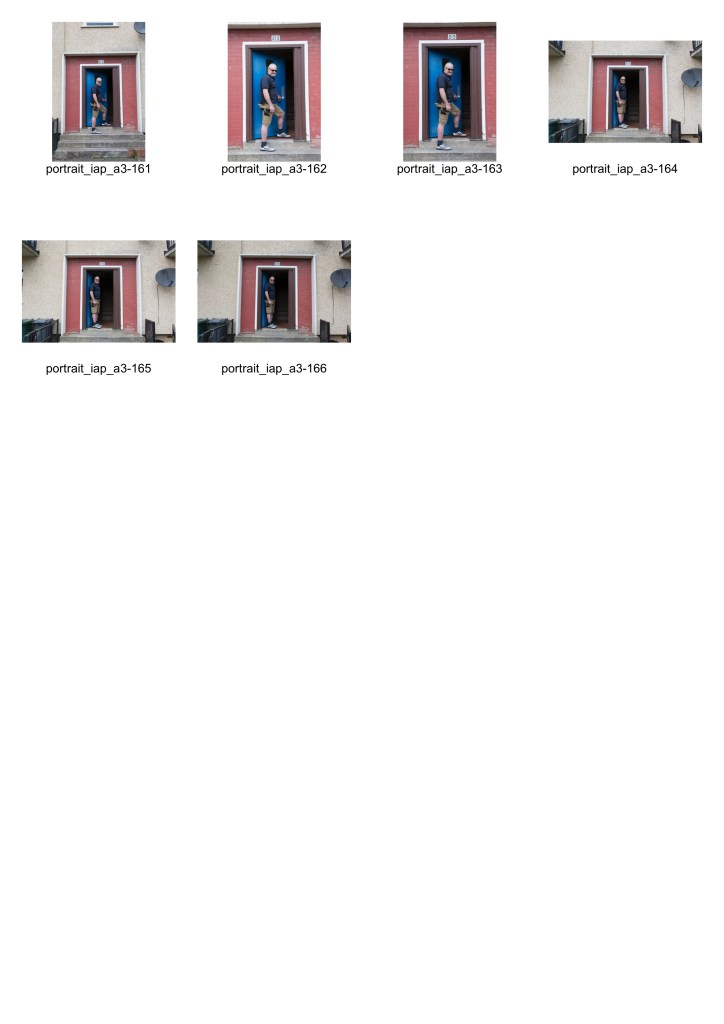
I decided to exclude this particular portrait from the final selection, simply because it’s very similar to that of image four, and isn’t as visually strong in regards to the photographic elements depicted. Yes, it has leading lines, depth, strong composition and placement of the subject – even symmetry. But, placed side by side with image four, it’s evident that these elements don’t create the same impact. Also, the juxtaposition I was trying to achieve between the ‘indoors’ and ‘outdoors’ isn’t apparent, and as a result, isn’t in line with the other portraits’.

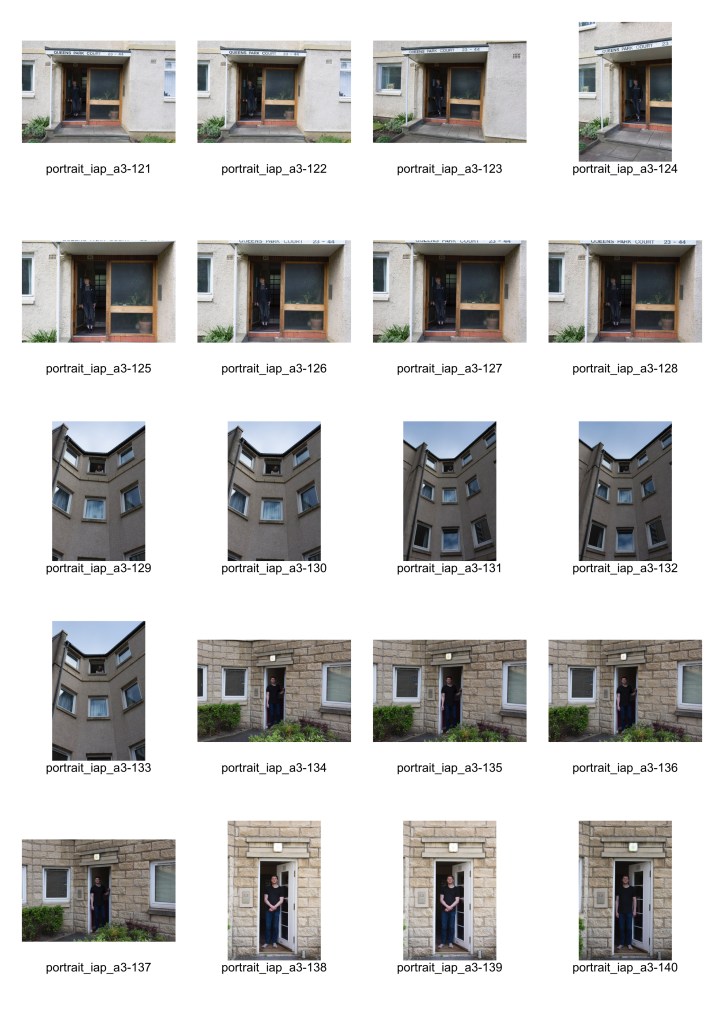
I knew almost immediately after photographing this subject that his portrait would not be included in the final selection. Throughout, I felt incredibly rushed – more so than the others – as surprisingly, there was a steady flow of individuals’ walking on the pavement directly behind me. I believe this affected my process, and rather than looking into how I could incorporate the required elements within the image, I was rushing to take photographs, with little thought about the end result. It’s evident that almost none of the elements I hoped to include, are present.   

Assignment Three: Mirrors or Windows – Initial thoughts, ideas and preparation

I’m feeling a lot more positive going into ‘Mirrors or Windows’ than I did for assignment two, despite still being in lockdown, and feel I’ve some good ideas that if perused, will hopefully enable me to produce a strong set of images. As suggested by my tutor, I’ll continue to explore the theme of ‘lockdown’, but will ensure that the topic of ‘community’ – the premise for this assignment – is met. I’ve done a lot of research into ‘communities’ and have discovered there are broadly speaking, five different ‘types’. These are: community of action, practice, place, interest and circumstance. It is the latter which I think is most relevant to this assignment, and the ‘type’ I will concentrate on specifically, as it explores how communities have been united due to a common situation or challenge not to their making, i.e. coronavirus / lockdown.
That brings me on to the main problem I’m facing currently – the aspect of ‘community’. Due to the current situation, the majority of communities have separated, and are currently non-functional for obvious reasons. Social distancing means that having close interaction with individuals’ – unless done in a safe manner for myself, the subjects’ and the general public – is almost impossible. Of course, there are some types of communities that could be explored. For example, the distant learning community, which is a great example of a ‘mirror’, and like any topic chosen within this category, could be done from the confines of my home, due to its self-reflective nature.

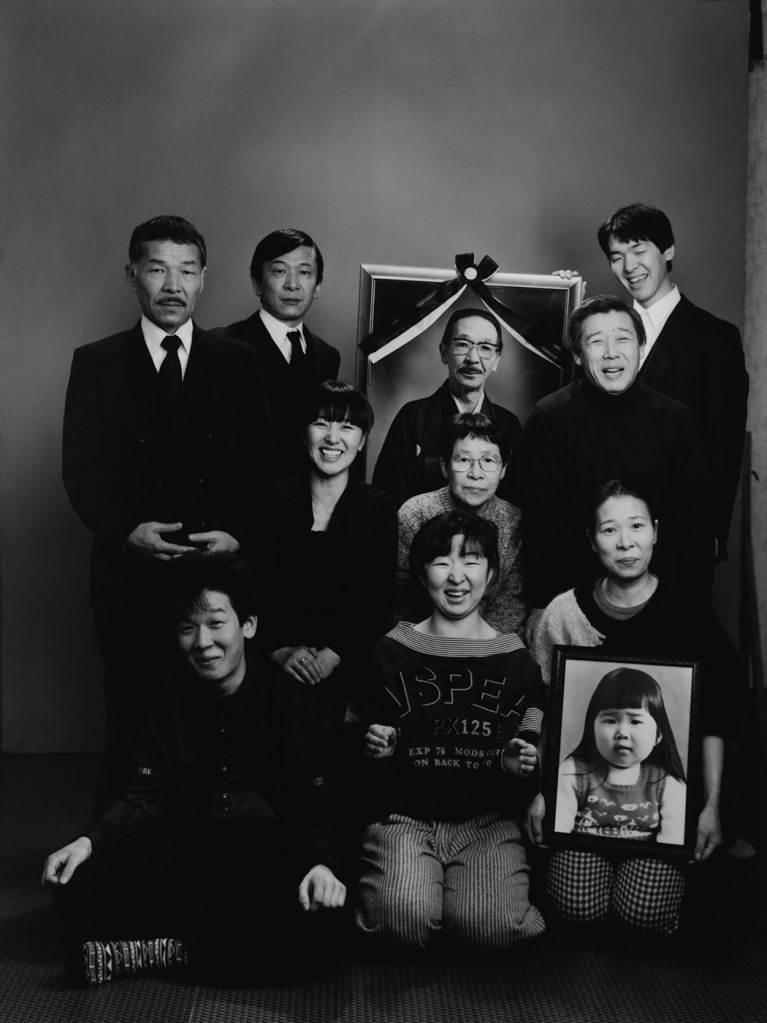
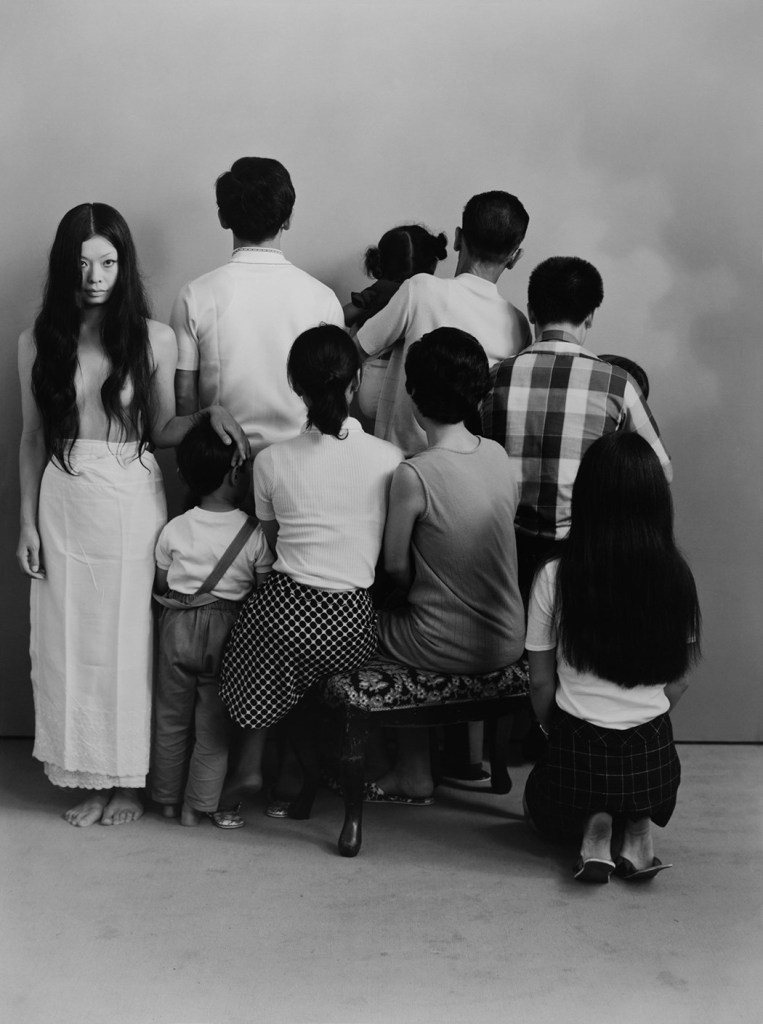
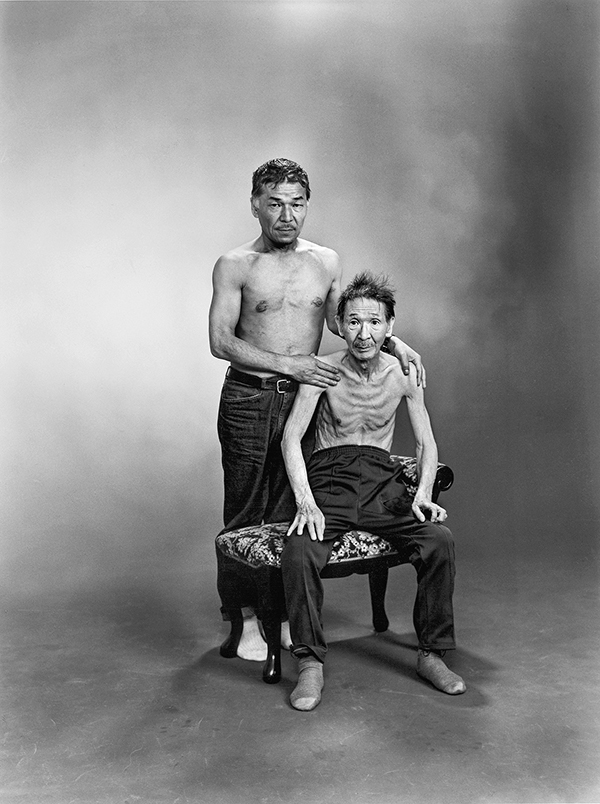
At present, I’ve only one idea that falls under the category of ‘mirror’. Inspired by the work of Japanese photographer Masahisa Fukase – specifically his photographs from the series ‘Family/Kazoku’ – my notion is to create a series of family portrait’s that reflect our feelings and emotions triggered by being in lockdown. Though, Fukase’s intimate portraits – that were taken over almost two decades – explore the theme of time passing and the changes to his family within this period – there are elements I’ve seen in his images that I’ve been drawn to, and feel I could adopt to my own portraits to portray the message I’m trying to achieve. In many of his photographs, we see family members holding up framed portraits of presumed deceased relatives. Of course, this wouldn’t be my reason, but, rather to show the family members we are unable to meet due to being in lockdown. However, the framed portraits used in Fukase’s photographs are large format prints, and his intentions for doing this are clear. Even though these individuals’ are deceased, he’s representing them as if they were present – alive if you will – standing or kneeling beside other family members. As a result, these portraits are incredibly powerful and do leave an impression on the viewer. Unfortunately, I own no large format prints of my family, and because of this, feel my images, in this regard, could lack in what Fukase was able to achieve. In other portraits’, we see his family with their backs turned towards the camera. I’m not certain what this represents, but, perhaps it’s depicting a family looking back (in time) and reflecting on what they were then, and what they’ve become – for better or for worse. Applying this notion within my portraits, my family could be looking back – metaphorically speaking – and contemplating our lives before, during, and even perhaps, after the coronavirus pandemic. I particularly like the portrait that shows Fukase himself, and I believe, his father. They are both topless and depicts clearly the effects ‘time’ can have on the human body. Fukase, who is still relatively young, appears strong and fit. Where his father, an elderly man by this point, appears weak and fragile. My idea is to take a self-portrait – topless of course – showing the effects lockdown has had on my body – specifically my weight gain – due to infrequent exercise that I’m usually accustomed to.

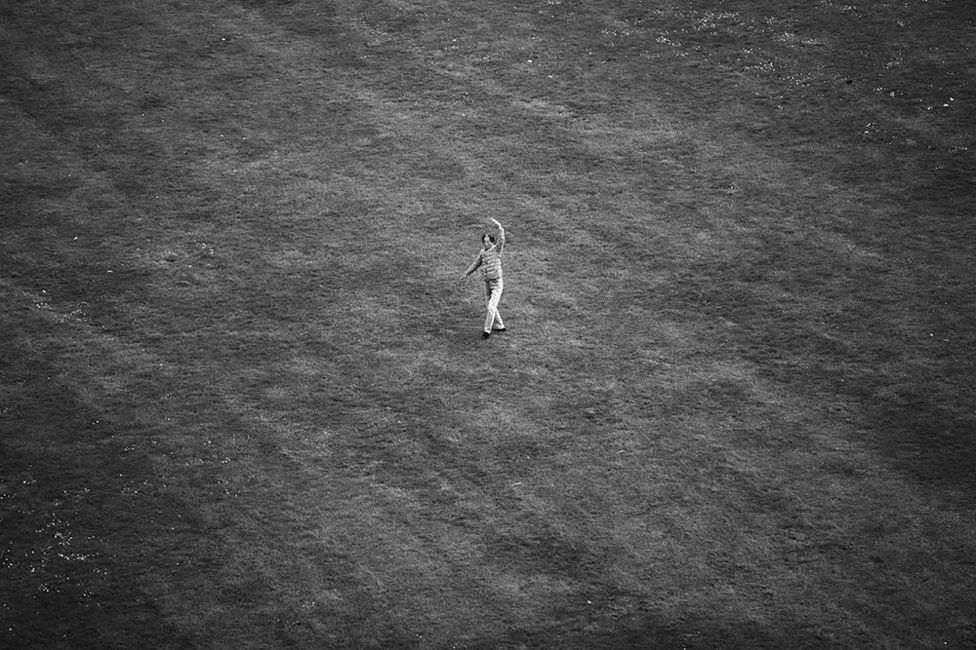
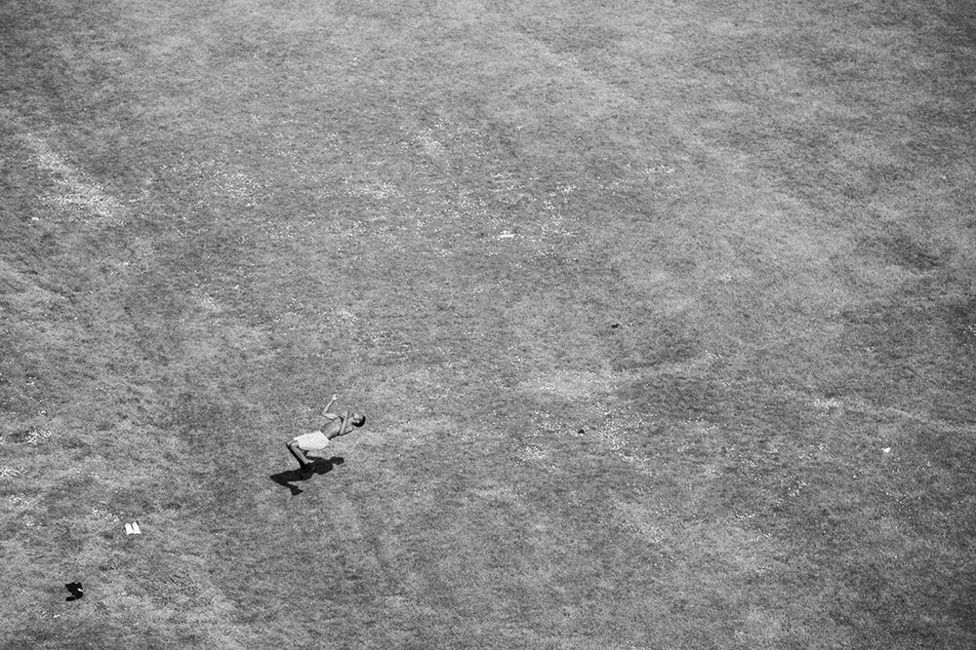
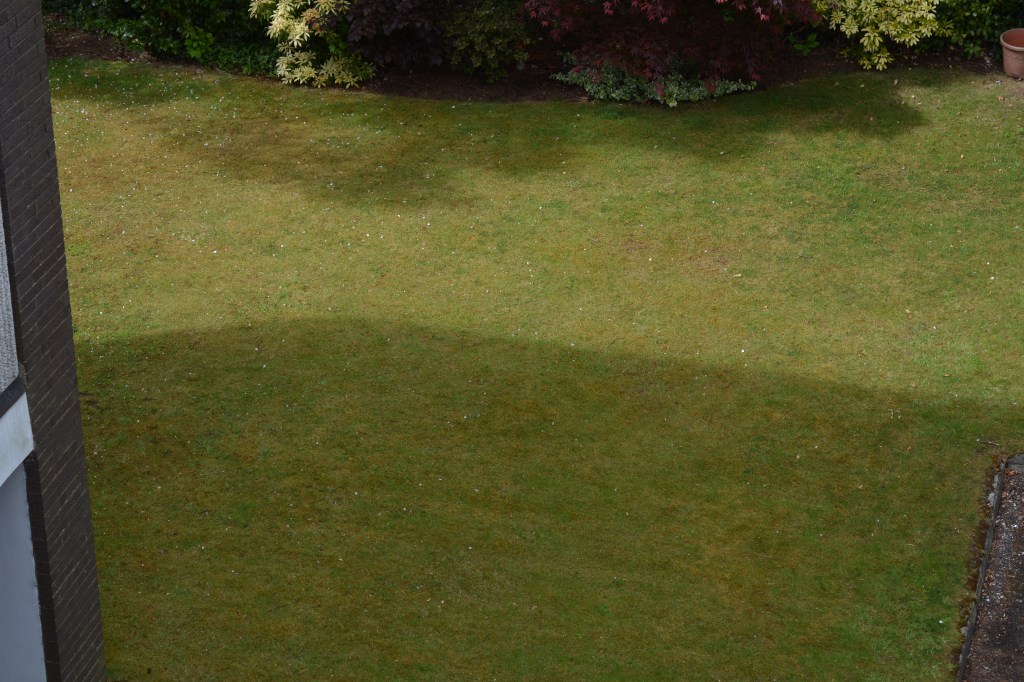
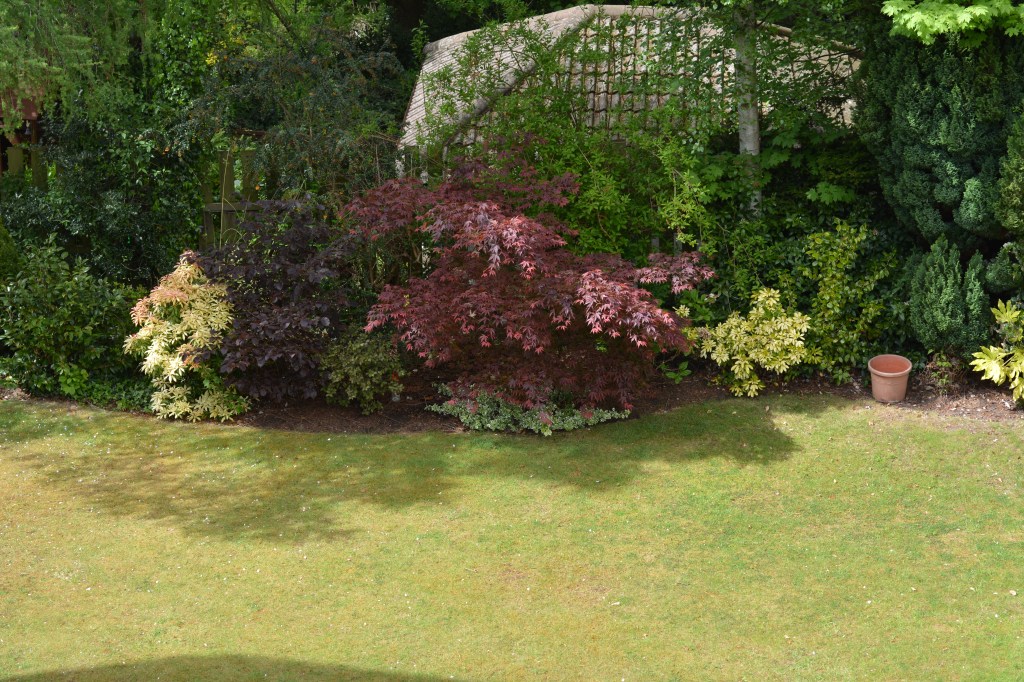
Whilst looking through the ‘photography’ section of the BBC news app, I’ve come across a visually beautiful photographic series aptly named ‘Field (2020)’ by photographer Jemima Yong. Her idea may seem simple, but in fact, it’s an accurate reflection of current times and depicts the notion of lockdown and social distancing extremely well. Her images show individuals’ – families and solitary soles alike – in a field that is overlooked by her home (where she took the photographs from) trying to regain some normality to their lives, if only for a short while. Though, like Yong, we know nothing about these individuals’, as a viewer, we get a better understanding of the communities they may belong to, just by observing the activities they are undertaking. I think this is a very fascinating way of gaining insight into local communities one might be unfamiliar with, and as a result, would allow my images – if I were to adopt a similar approach – to operate like a ‘window’. My ‘field’ would be a small area of garden behind the block of flats where I reside, which is sometimes used by the local residents for various activities – sport, relaxation, work etc. I overlook a section of this garden from my top floor flat, so have a great vantage point for taking photographs in a safe and discreet manner. One thing Yong does extremely well, and a compositional technique I often use, is the use of negative space. I think it isolates the main subject(s) within the photograph, thus, placing a stronger emphasis on them. I’ve taken a couple of test shots, and unfortunately, I’m unable to create the negative space which I desire, due to unwelcomed objects visible within the scene. Of course, there is the option to crop my images to eliminate these objects from the final image, but again, I feel this would be counterproductive in what I’m hoping to achieve visually. However, this certainly isn’t an idea I’ve excluded, and may in fact – after more planning – pursue further.

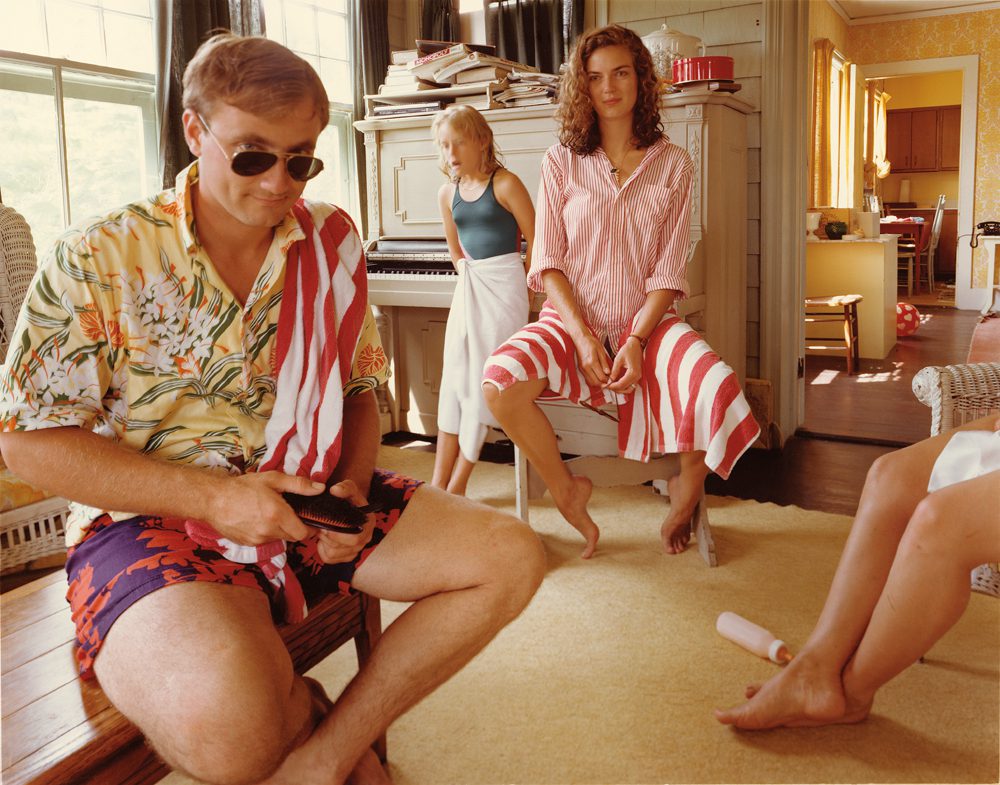
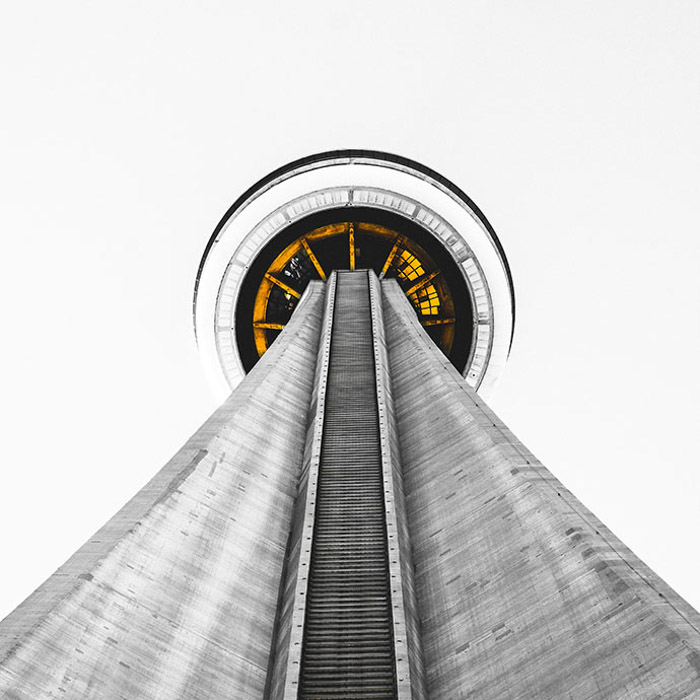
Currently, there are a lot of photography projects being done – surrounding the theme of ‘lockdown’ – where individuals and families alike, are being photographed through their windows or doorways, to represent isolation and social distancing. I’ve thoroughly enjoyed looking through these types of images, and feel they are an important documentation of current events, which will hopefully stand the test of time. However, I’ve noticed on many occasions, details surrounding these individuals’ are vague, and as a viewer, we don’t really get a sense of who these people are. However, I fully appreciate under the current circumstances that each photographer will have limited time with their subjects’, so, obtaining more information on them, just wouldn’t be possible. I’ve thought about ways in which I could create a similar project, specifically related to the communities that the subjects’ belong to. Unfortunately, I will not be able to spend time within these communities – as the brief for ‘windows’ suggests we do – so an alternative method is of course needed, but needs to be one that can be done in a safe manner for everyone involved. I’ve thought about creating a questionnaire – related to communities – that I would deliver around my local area. These documents would ultimately support the portraits of those who completed them – if they chose to participate further – which I’m hoping will offer the viewer a better insight into their community lives. I feel it’s important to strengthen the notion of social distancing, so would take into consideration the idea of ‘distance’. However, it’s vital that the subjects’ don’t become lost in the space created, so using leading lines to draw the viewer towards them is also a factor I must consider. I’ve revisited Tina Barney’s work, to gain a better understanding on how she creates space, and noticed that in many of her images, the inclusion of an open door is used, which results in the photographs depth – or ‘distance’ – being increased instantaneously. I believe I may have opportunities to apply the same photographic technique within my images. I’ve also done some brief research into architecture photography, to see how ‘lines’ – created by the buildings themselves – can be used effectively, which in my case, would be for the sole purpose of leading the viewer towards the subject and perhaps framing.

References

Fever Bee. (2010). ‘Types of Communities’ [Online] Available from: https://www.feverbee.com/wp-content/uploads/2010/11/TypesofCommunities.pdf

AnOther. (2019). ‘Masahisa Fukase’s Intimate Portrait of His Own Family’ [Online] Available from: https://www.anothermag.com/art-photography/11964/masahisa-fukase-family-kazoku-mack-books-2019

Creative Review. (2019). ‘Masahisa Fukase’s family portraits taken over 20 years’ [Online] Available from: https://www.creativereview.co.uk/masahisa-fukase-family-mack/

Aperture. (2019). ‘Father Figure’ [Online] Available from: https://aperture.org/blog/masahisa-fukase-family/

Jemima Yong. (2020). ‘Field (2020)’ [Online] Available from: https://jemimayongphotography.format.com/field-2020#0

BBC News. (2020). ‘Coronavirus: The view from my window’ [Online] Available from: https://www.bbc.co.uk/news/in-pictures-52298901

BBC News. (2020). ‘Coronavirus: London photographer captures life in lockdown’ [Online] Available from: https://www.bbc.co.uk/news/uk-england-london-52282795

WordPress. (2020). ‘Tina Barney’ [Online] Available from: https://iainbarbourocaiap.photo.blog/category/research-and-reflection/

Expert Photography. (2029). ‘The Complete Guide to Architecture Photography: 98 Tips’ [Online] Available from: https://expertphotography.com/complete-guide-architecture-photography-98-tips/

Eric Kim Photography. (2020). ‘7 Leading Line Photography Composition Tips’ [Online] Available from: https://erickimphotography.com/blog/2017/02/23/6-tips-to-integrate-leading-lines-into-your-photography-composition/

Assignment Three: Mirrors or Windows – Reflections

I certainly feel I challenged myself with this assignment, and could have chosen the more obvious option of ‘mirrors’, which I believe would’ve been an easier process all round. I feel under the difficult circumstances I faced, I adapted to an almost impossible ‘windows’ brief, and by using what I’d consider to be an imaginative alteration in regards to how it was approached, I was still able to achieve what was required. For me, the questionnaire was the safest means to gaining information about communities and those associated with them. However, I do believe under different circumstances, I would have had greater results in regards to responses, and understandably, people were reluctant to take part in the process. Still, those who did, were absolutely fantastic, and I think showed the optimistic spirit that is needed right now. The process of creating the portraits’ was certainly testing, as I usually like to take my time and be methodical with my approach. Of course I wanted to take lots of purposeful images of my subjects’, but at the same time, spend as little time with them as possible, as my primary concern throughout was the well-being for everyone involved. I believe I got the balance right, and though I didn’t overstay my welcome, I took enough photographs of each subject for it to be beneficial when making a selection for the final series.

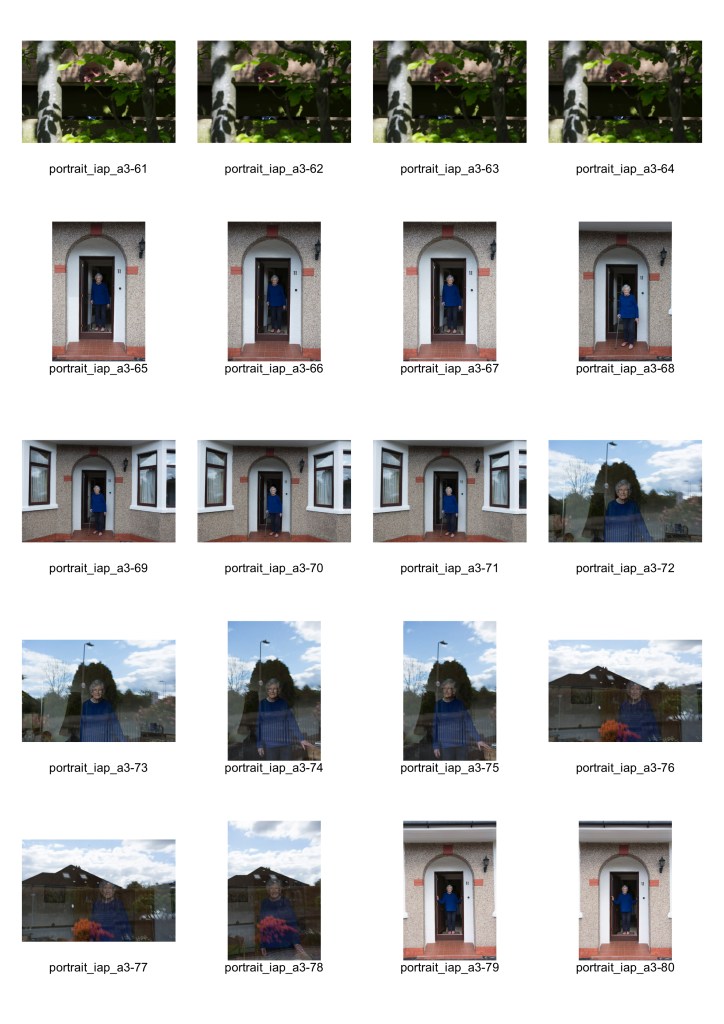
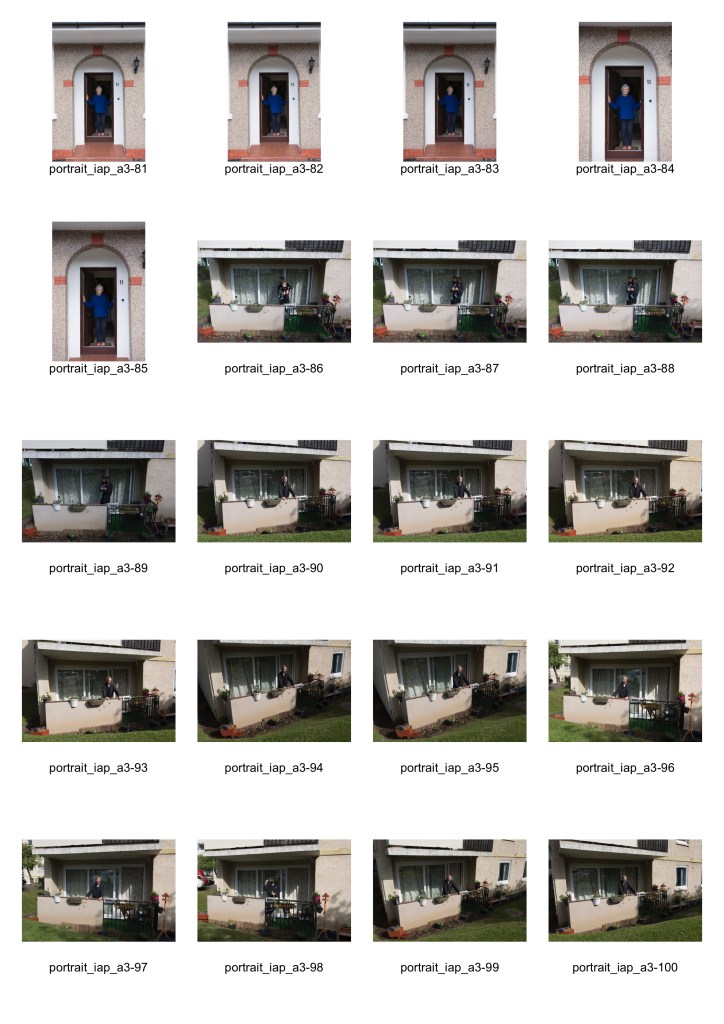
Technically, the process of taking the portraits’ was relatively straight forward. I swapped between two lenses – 18-35mm and 60mm – depending on the type of image I was trying to create, and what information I wanted included within the scene. I had to use manual focus for images 1 and 2, as the branches / leaves on the trees, and the reflection in the window, affected the autofocus considerably. I very rarely use manual focus, but as both subjects’ were fixed in one place, it wasn’t a difficult undertaking. My compositional technique is something I’ve been working very hard on, and I believe this is reflected in my images. Emphasising the notion of social distancing and isolation for the viewer, whilst making sure the subject remained the focal point, was probably the most important factor to consider, but the hardest to achieve. Consciously using leading lines in my photography isn’t something I do often, so having to view a scene and determine where to place my subject, based on what ‘lines’ will be most beneficial in terms of making them the point of interest, whilst considering the composition as whole, was very challenging for me. However, I think my use of leading lines are very effective and purposeful, and actually, apart from image three, are quite subtle. Framing my subjects’ effectively was easier to achieve, as the building structures themselves – on some occasions – created these frames for me. My subject in image one though, was the hardest to ‘frame’. Because I wanted the distance between myself and the subject to be less than the others – because I was able to – I ultimately removed the natural, but perhaps obvious ‘framing’ object from the scene – the window frame. However, I noticed the reflection of the dark hedge in the window, and felt it would work well at both highlighting my subject, but framing them also. I’m very pleased that I’ve be able to apply layering and depth within all my images – even image one which I didn’t think would be possible. I think the best example of this though is seen in image four, where by simply placing the subject to the side of door frame, the viewer is able to see to the very back of the scene, making it appear larger than it actually is. Plus, we get to see an interestingly designed door, which is also acting as a back light for the subject. The concept of juxtaposition is something that took me a while to understand, and honestly, is something I’ve never considered applying into my photography until this assignment. I tried very hard to depict both natural and manmade elements i.e. the buildings, and think there is a nice balance of each within all portraits’. I particularly like image four in this regard, as the ‘natural elements’ are subtle and requires the viewer to investigate the image closely to receive that information.

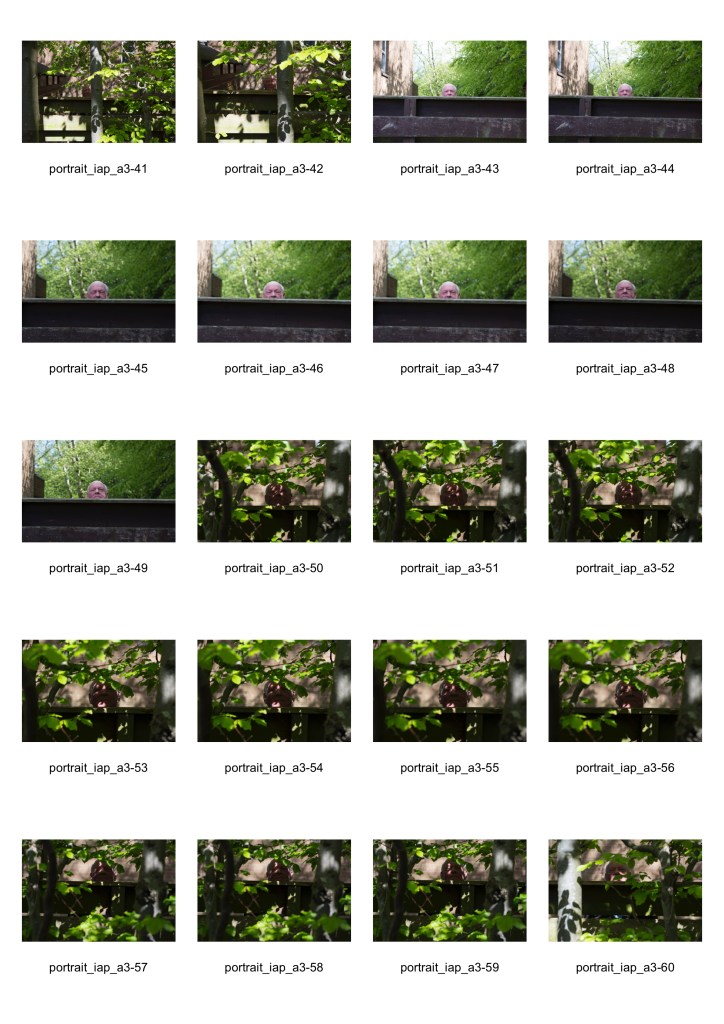
I always like to be creative as possible with my photography, and this assignment was no exception. I could have easily produced eight images of individuals’ standing at windows or in doorways, but that would have made for a rather boring and repetitive set of images. Instead, I used a variety of locations, and particularly enjoyed choosing objects that would represent the subjects’ ‘barriers’ to emphasis the idea of social distancing and isolation. Image two is a great example of this, as by just making the subjects head visible, it gives the impression that he doesn’t want to expose himself too much to other people. It also makes for quite an amusing photograph, despite the negative connotations surrounding it. I also tried to experiment with visual perception, and think the images’ where this has been applied work well. Obviously, for images’ three and five, I had no choice to photograph the subjects’ from below, so the perception created was inevitable. However, for image six, I purposely stood on top of the hill – which I didn’t have to – to get a view of looking down on the subject that ultimately helps create distance.

Overall, I’m very happy with the way I approached this assignment, and ultimately, with the images that I have produced. I think the questionnaires support the portraits’ effectively, and offers the viewer some insight into who the subjects’ are and the communities they are linked to. I have carefully considered the order my images should be presented in, and though I feel they all have a place within the final series, the images I consider ‘better’ are at the start of the set.

Assignment Three: Mirrors or Windows – Tutor feedback

As my tutors report can be found on my blog, I won’t repeat what has already been written, but will however, reflect on some of these points further and mention topics that have not been included that I believe to be important for my development. 

To be honest, only a short time from our discussion was spent talking about my assignment. However, from the feedback I did receive, I left the call feeling happy with the thoughts my tutor had on it. Overall, he appreciated the effort I put in – especially under the difficult circumstances – and thought the inclusion of a questionnaire was a clever way of gaining information about individuals’ and their communities, but also made the project more ‘personal’ – something I’ve been working hard on since assignment one. He also noted the variety between each of my images’, which I was pleased about, as this was an important part of the brief and something I worked hard on to achieve. We discussed the use of flash – again – and how by using it, my images would benefit greatly, if used in the right situations. For example, he felt that if I had used flash in image four and six, it would have acted as a fill light, highlighting the subjects’ and enhancing them within the image. We have discussed using flash before, so for the next assignment, I must use it if I think it will be beneficial.

My tutor made a very good point about my presentation of my posts on my blog. I currently do this in a very systematic way, for example my ‘initial thoughts and preparations’ are at the top, with my selection of images near the bottom. He explained for assessment purposes, I need to do this differently, and by having an ‘assessment’ tab perhaps, produce a short written explanation that supports each assignment, followed by the relevant images. This means if the assessors want to read such things as my main essay, or my ‘reflections’, they can do so by navigating through a separate tab.

We discussed the importance of why images should ‘sit well’ together within a set, and ways of achieving this. My tutor mentioned he makes prints of his photographs, as having physical copies in front of you, is very much different to reviewing them off a screen, for example. That got us talking about printers, and if it would be worth me investing in one. I’m still not sure, and think it might be cheaper, but perhaps not easier, to have an online printing company do this for me. I learnt about a process called ‘lightjet’ printing, which sounds interesting and something I will do further research on.

Exercise 4: The gaze

  • The spectator’s gaze – the look of the viewer at a person in the image.
  • The internal gaze – the gaze of one depicted person at another within the same image.
  • The direct address – the gaze of a person depicted in the image looking out directly, as if at the viewer (through the camera lens).
  • The look of the camera – the way the camera itself appears to look at people depicted in the image (the gaze of the photographer).
  • The bystander’s gaze – the viewer being observed in the act of viewing,
  • The adverted gaze – the subject in the image deliberately looking away from the lens.
  • The audience gaze – an image depicting the audience watching the subject within the image.
  • The editorial gaze – the whole ‘institutional’ process by which a proportion of the photographers gaze is chosen and emphasised.

When we think back to an event we have attended, or, a holiday we’ve been on, it is often the case that we cannot remember every specific detail, or, moment that we encounter. I find it amusing when we hear the term “an unforgettable experience”, as I find the longer time passes, certain details surrounding it can become fragmented. As we know, photography is a fantastic way to rekindle those memories. When we revisit those images we took – however long ago – we usually have the ability to take ourselves back to an exact moment and reconnect to that experience, which we may have struggled to do otherwise. This is very much relatable to John Berger’s theory that photography is able to create a loophole in time, connecting the moment a photograph was taken, to the time it is viewed – despite the length in between. Of course, this is a theory very different to that of Henri Bergson, who coined the term ‘pure memory’, which allows us to store away our memories essentially, and recall them when desired. I think though in regards to photography, Bergson’s theory perhaps should be err on the side of caution. I agree that most people will have ‘pure memory’, but those types of memories will certainly be limited. If, as photographers, we relied on this theory too often, the amount of photographs we would actually take would dwindle – unless it was being done, purely for others to see.

For this exercise, I have chosen five images that I took during my holiday in China, as due to the lockdown situation, I was limited in terms of subjects’. During my trip, I took a lot of photographs of people. However, my memories of what they looked like and how they were reacting in the images had been forgotten. I saw this as an interesting opportunity to revisit these images and specifically look for the different gazes that were evident, but unbeknown to me at the time of taking the photographs.

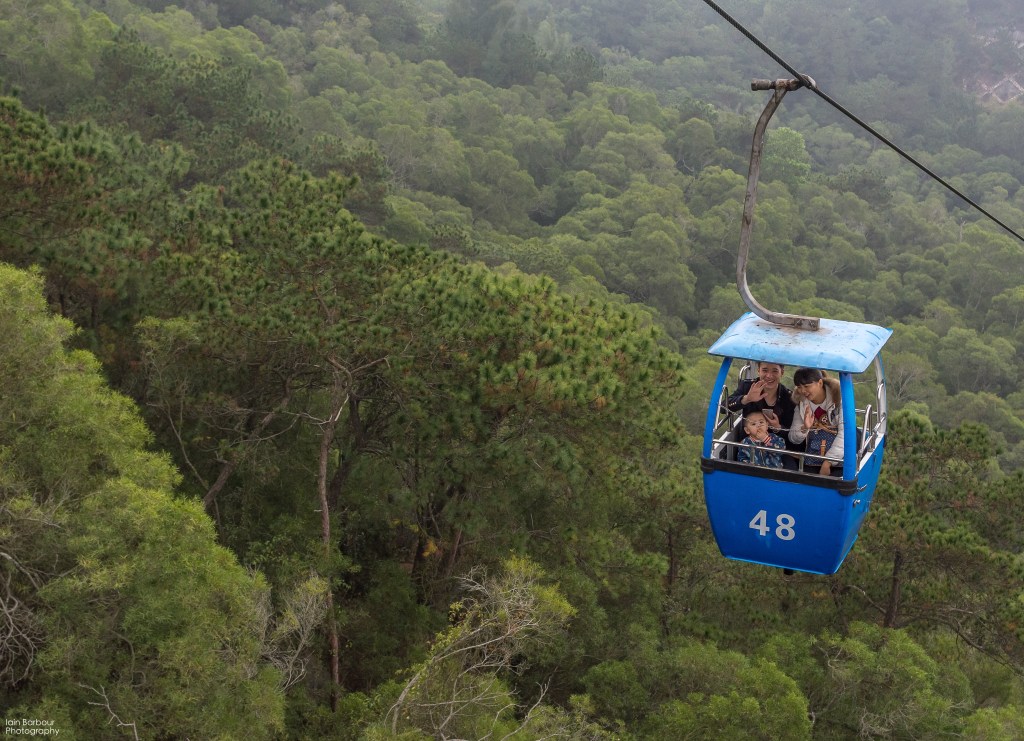
The internal gaze

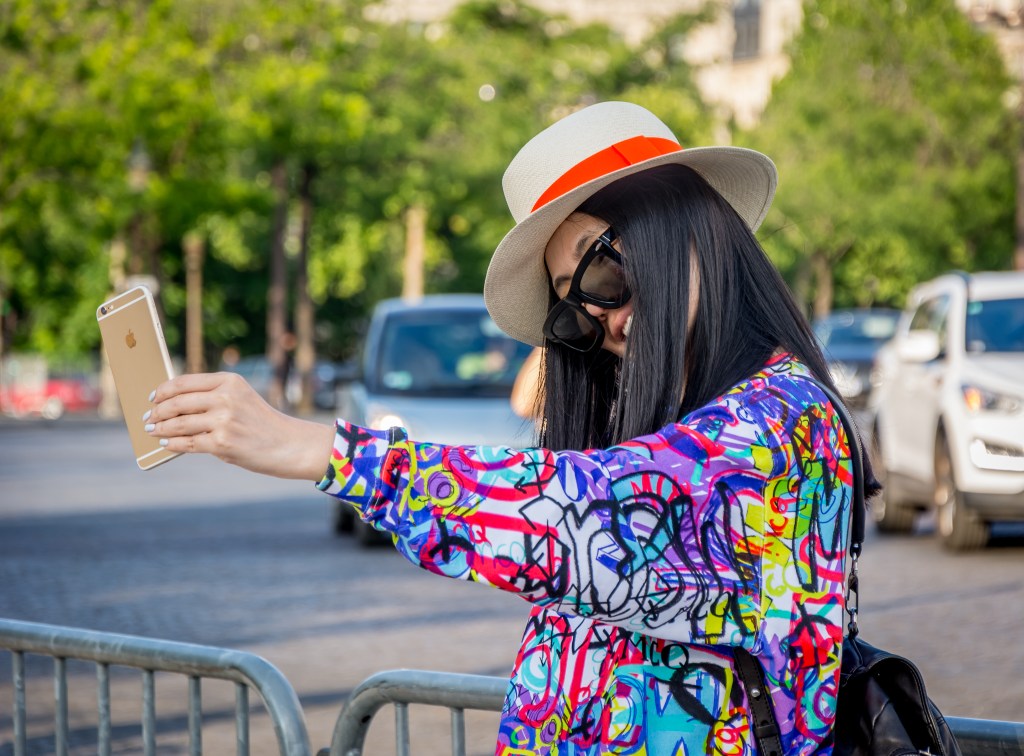
Although there is only one person evident within the frame, what is being implied here is an interesting and clever take on the internal gaze.

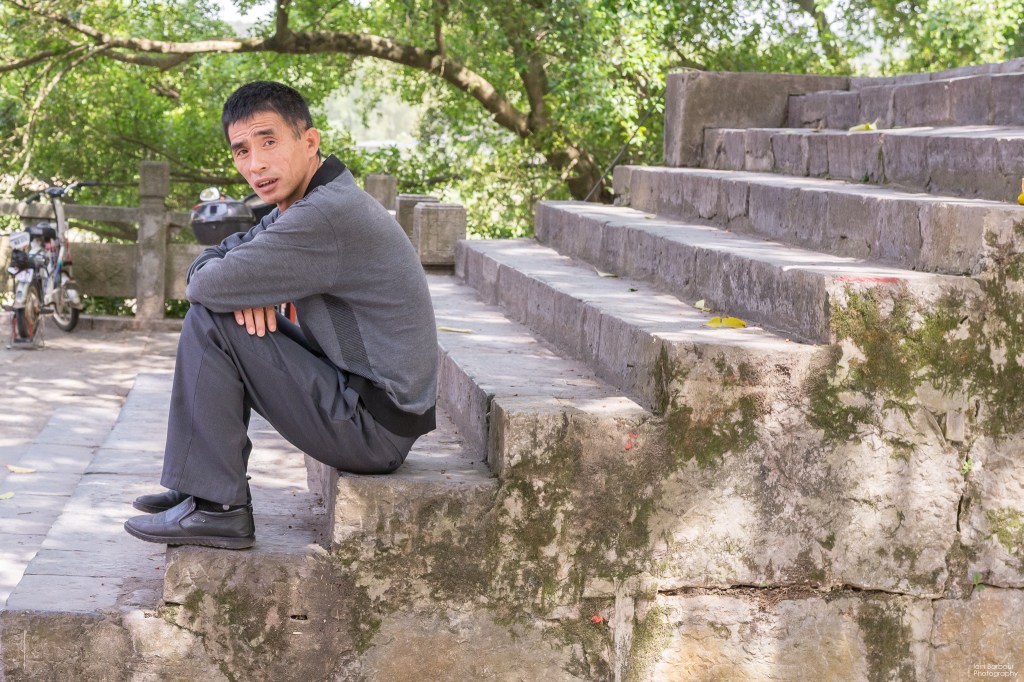
The direct address

This image is self-explanatory, but non the less, a great example of the subject looking directly down the lens.

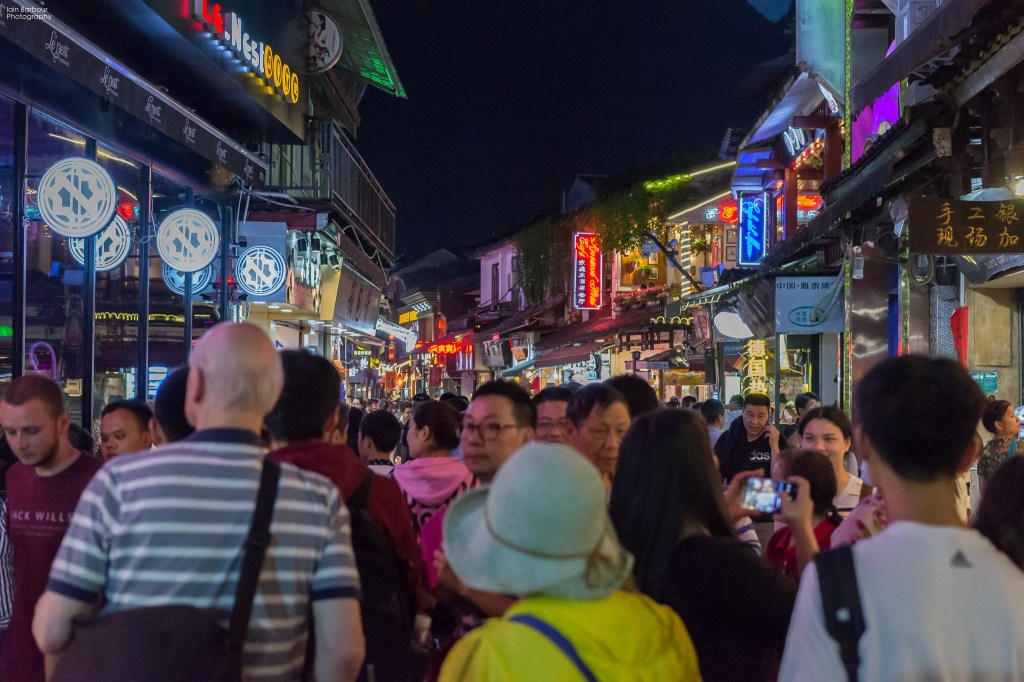
The look of the camera

This image is effectively my gaze at those individuals’ within the scene. Taking into consideration the height the photograph was taken and, the close proximity of the people, how will the viewer feel?

The Bystander’s gaze

This is a subtle example of this type of gaze – possibly due to the distance between the camera and subject – but strongly depicts the main viewer – the little boy – being observed in the act of viewing.

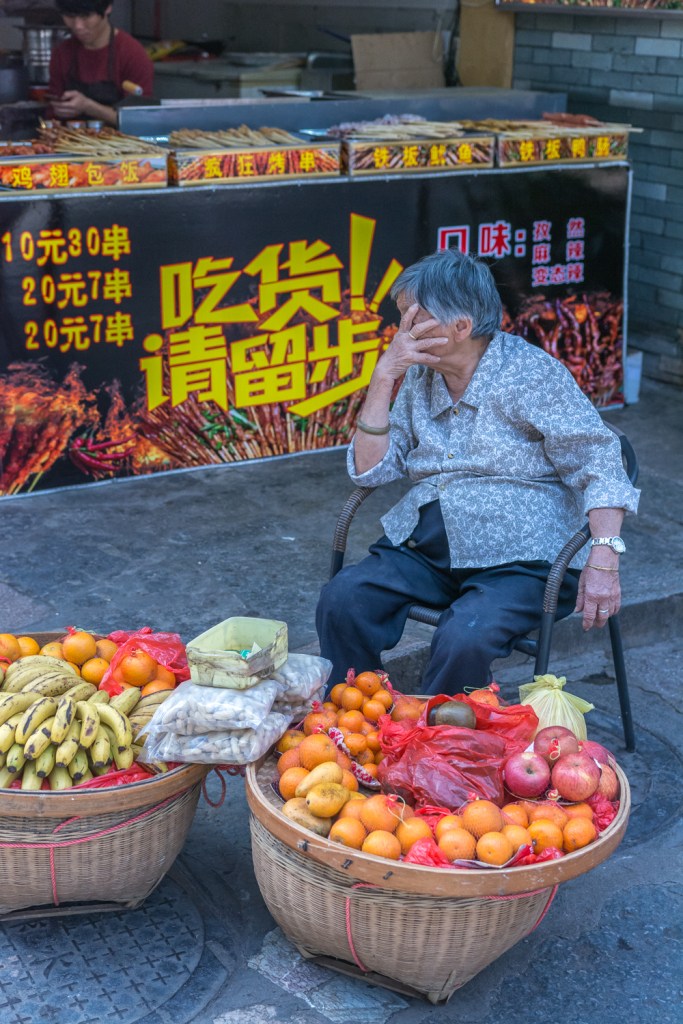
The adverted gaze

This shows a strong and, perhaps uncomfortable example of the adverted gaze, where looking away deliberately simply isn’t enough.

Exercise 3: Reflecting

For centuries there has been prejudices made towards individuals or groups, who are considered by those making those judgements, to be insignificant to them. As long as there are people on this planet and class systems present, this will never change. Though this attitude cannot be justified, I do think for the majority, the way they think or act towards these individuals is a direct result of their upbringing, lack of education and of course, the social group they belong to.

The reasons why these individuals’ or groups have been portrayed badly, or, unhelpfully, has of course changed over the years. But, could it be more difficult for these people in today’s society? I think it could be. I believe the media is a contributing factor and, we are seeing ever-increasing ways to portray these people – fairly or not – to those who may not fully understand the situation, or their circumstances and, who have the ability to make their feelings known to all at a click of a button. Its one thing seeing this negative and cruel attitude within the general public, but when “world leaders” such as Donald Trump are targeting these people quite openly, you have to think what hope do we have in eliminating this? What social group we belong to can of course help fuel this prejudice even further. The biggest challenge here I feel are the influences other’s within the same group could have on someone who doesn’t necessarily share their views – whatever they may be. I think it’s very common for these views to rub off on people, so to speak, the more you associate with them, and the cycle continues.

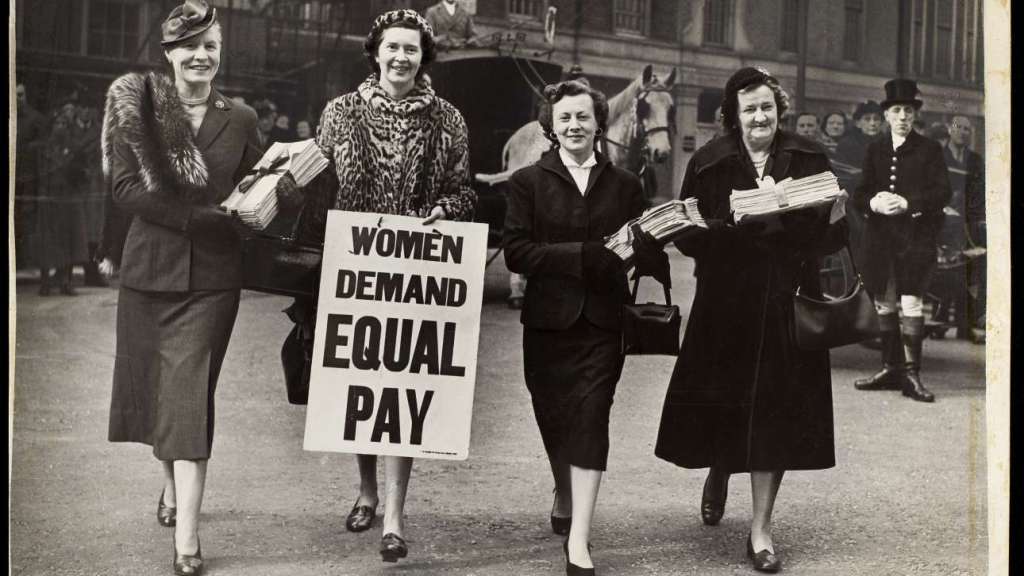
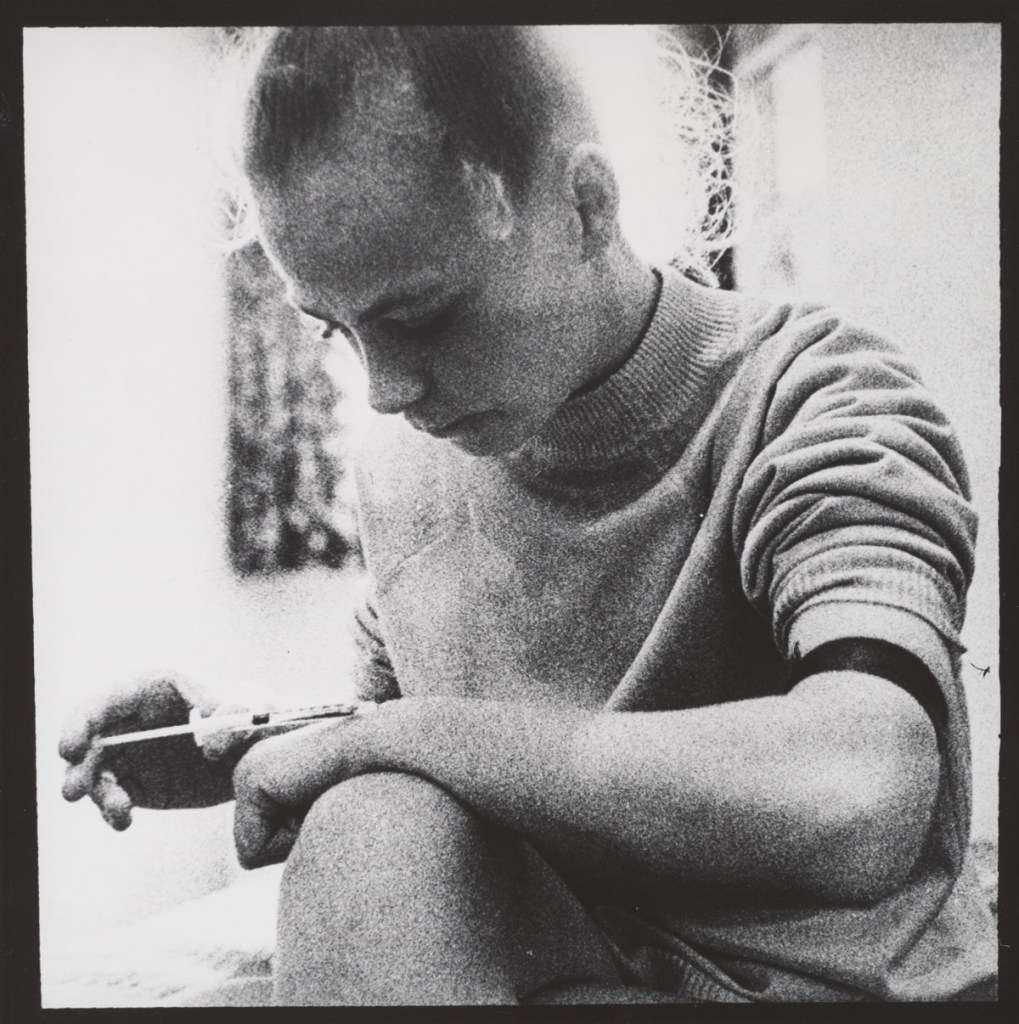
When it comes to incorporating this topic into your photography, I think the line of being insensitive towards these individuals’ and groups could easily be crossed. I believe the reasons why a photographer is wanting to explore these types of situations and people, will depend on how derogatory their work will be viewed by others. For example, are they choosing to photograph women in what could be considered ‘male orientated’ roles, to highlight that they can’t do the job, or, to emphasise that this is a serious issue and effectively promote a problem that needs to be addressed. Perhaps, what is chosen to be photographed surrounding these subject’s being discussed will also be of some importance. For example, if the photographer was doing a series on drug use, rather than images depicting the taking of drugs – which may promote negative connotations – showing the effects the use of drugs can have, for example, broken relationships, might create a more empathetic feeling towards the subject and those involved.

As a photographer, I think being involved with one of these marginalised or under-represented individuals or groups, would be extremely beneficial in how and why we take photographs of them. By allowing photographers to have a better understanding of those involved and build relationships with them, we can ultimately present them and the situation in an empathetic way. I believe being unbiased about the topics you are photographing is favourable, however, in this instance, it still leaves room for misinterpretation by the viewer, that could lead to prejudice. It would also make us – the photographer’s – reflect on how we would want to be portrayed if in a similar situation, and therefore, may be more selective in what we decide to photograph.

References

University of London. (2020). ‘Equal pay for equal work: Jill Craigie’s To Be a Woman’ [Online] Available from: https://london.ac.uk/news-and-opinion/leading-women/equal-pay-equal-work-jill-craigies-be-a-woman

On Curating. (2020). ‘Shooting Up in the Museum: Intravenous Drug Use in Brian Weil’s The AIDS Photographs’. [Online] Available from: https://www.on-curating.org/issue-42-reader/shooting-up-in-the-museum-intravenous-drug-use-in-brian-weils-the-aids-photographs.html#.XqH9OGhKjIU

Design a site like this with WordPress.com
Get started